
 English
 Français
 Deutsch
 Italiano
 Turkish
 Greek
 Serbian
The Japan Times Features Special Article on Albania for Flag Day




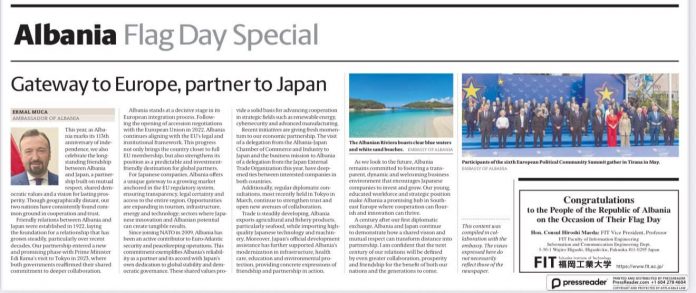
As part of Albania’s 113th Independence anniversary, the prestigious Japan Times has published a special feature dedicated to Albania, highlighting the country’s history, culture, and the growing ties between Albania and Japan.
Albania’s Ambassador to Japan, Ermal Muça, shared the publication, which coincides with Flag Day and represents an important acknowledgment of Albania’s image in one of Asia’s most respected media outlets.
The Japan Times article sheds light on Albania’s historic journey, its achievements, and its constructive role on the international stage. It portrays Albania as a nation rich in cultural heritage and full of economic and tourism potential.
“As we proudly celebrate our national holiday, the esteemed daily Japan Times has featured a special article dedicated to our country in its November 28 edition, marking Flag Day,” Ambassador Muça stated, extending his best wishes to Albanians everywhere on this important day.
Full article below:
Every November 28, Albanians worldwide celebrate their independence. It is a day to take pride in our long history and reflect on the challenges ahead.
As Albania’s Ambassador to Japan, it is my honor to extend, on behalf of my country, best wishes for health, peace, and prosperity to Their Imperial Majesties Emperor Akihito and Empress Michiko, the Japanese government, the welcoming Japanese people, and the Albanian community residing in Japan.
I am also pleased to address the readers of The Japan Times and share my thoughts on this important day, as well as the strong and growing relationship between Albania and Japan, which marks 91 years of diplomatic ties.
Historically, the Albanian ethnos is one of the oldest in Europe, tracing its roots to the ancient Illyrian tribes of the southwestern Balkans. Despite centuries of foreign control, Albania preserved its language and traditions. Under the leadership of the legendary Skanderbeg, it enjoyed a period of independence, though full sovereignty was only declared in 1912, when the Albanian Renaissance leaders proclaimed Albania independent in the city of Vlora on November 28.
During the 19th century, Albanians resisted religious and cultural assimilation. Intellectuals of the national awakening movement championed the motto, “The religion of Albanians is Albanianism!” They formed the Albanian League in 1878 to unite the country, develop a new alphabet, and advance education and literature.
Since 1991, Albania has undertaken democratic reforms, moving toward a market economy and integration with Euro-Atlantic structures. Within four years, Albania joined the Council of Europe. In 2009, it became a NATO member. Following democratic parliamentary elections and peaceful transitions of power, Albania is now on track to achieve European Union Candidate Status.
Albania’s foreign policy focuses on integration into Euro-Atlantic institutions. The country promotes regional security, good neighborly relations, and peace, under the guiding principle of “zero problems with neighbors.” Over the past two decades, Albania has strengthened its regional role, supported Kosovo’s U.N. membership bid, advanced human rights for Albanian communities, and implemented the Ohrid Agreement.
Albania and Japan share a deep and multifaceted partnership spanning politics, security, economy, trade, agriculture, tourism, culture, and sports. Special emphasis is placed on energy, mining, and tourism. Tourism promotion remains a priority, supported by investments in roads, accommodations, and infrastructure, as well as the country’s rich natural landscapes. Albania has recently been highlighted by Lonely Planet as a top travel destination, attracting a growing number of visitors each year.
At the JATA Tabihaku Travel Fair in September, Albanian agencies introduced Japanese audiences to diverse tours and opportunities in Albania and the region.
Albania’s economy is a transitioning trade economy, with the private sector dominating GDP. Structural reforms, privatization of strategic sectors, macroeconomic stabilization, and public investment programs have strengthened the business climate. Close cooperation with international organizations, such as the World Bank, IMF, EU, and EBRD, further supports steady growth.
The conditions are now favorable for major Japanese direct investment across all sectors. Japanese citizens can travel to Albania without visas, and Albanian nationals increasingly visit Japan for tourism and business. Albanian citizens are also learning Japanese and showing strong interest in Japanese culture and social trends.
Të ngjashme








Most read










 RTI