
 English
 Français
 Deutsch
 Italiano
 Turkish
 Greek
 Serbian
The Spanish daily “Travesías”: Albania, the European destination under the tourist radar




Welcome to Albania, one of the least explored countries in Europe. Travelers who come here are surprised by the gastronomy, cultural wealth, and Albanian character that is unlike any other country. Maria Pellicer writes in an article published in the Spanish daily “Travesías.”
Tirana
Albania is one of the smallest countries in Europe, covering only 28,748 square kilometers, ranking 37th in terms of area on the continent.
However, despite its modest size, Albania takes pride in the richness of its history.
Looking beyond its recent history, which includes Enver Hoxha’s dictatorship and the challenges it faced during its integration into the global economy after 1991, Albania has always stood out as a unique country.
Reading the writer Ismail Kadare is enough to grasp the distinctiveness of Albanian culture in comparison to the rest of Europe.
A good starting point is “File H,” published in 1981, where Kadare narrates the story of two foreign scholars who arrive in Albania to study its poetry but encounter a closed and provincial world. Another compelling work is “Dream Palace,” a dystopian tale where the government records the dreams of its citizens to control them, inevitably evoking thoughts of the dictatorship era.
Among the dilapidated buildings and old houses transformed into clubs, bars, and restaurants, the Bllok neighborhood feels remarkably serene in the mornings.
In Tirana, fragments of history are ever-present, from the dictator’s house without any fence or barrier to conceal it from the gaze of both travelers and locals.

The pyramid, originally intended as a museum dedicated to the same historical figure, has now been transformed into a technology center.
Some of the abandoned bunkers within the city have been transformed into galleries and museums, while the remnants of the old castle have been converted into an open-air shopping mall.
In the heart of the city, a broad avenue lined with Mediterranean pines evokes the distinctive fascist style influenced by Italy during the reign of Zog I, which culminated in the occupation in 1939 and annexation until 1944, the year when the dictator Hoxha came to power.
Edi Rama, the Prime Minister of Albania, is not only a politician but also a painter and a basketball player.
Tirana is a relatively small city, but it’s very pedestrian-friendly.
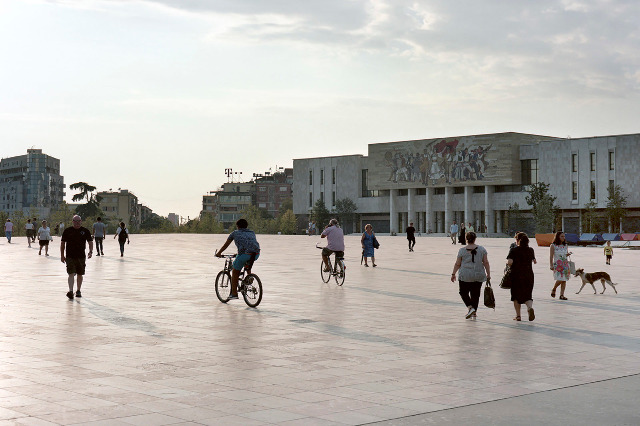
In the city center, you’ll find Skënderbej Square, which was redesigned through a collaboration between the artist Anri Sala and the S1N4E office. They covered over 90,000 square meters of the square with marbles of different colors.
In the backdrop, the Opera House and the National Historical Museum majestically frame the space.
At the entrance of the museum, a remarkable Albanian mural created by Vilson Kilica, Josif Drobonik, Agim Nebiu, Anastas Kostandini, and Aleksandër Filipi narrates the country’s history from ancient times to the communist era.
Recently restored through funding from the European Union, which aimed to rebuild areas affected by the 2019 earthquake, the mural has regained its brilliance. It captivates travelers, featuring the central figure of the Republic raising the national flag with one hand, set behind a backdrop of red and black.
Berati

While Tirana has much to offer, the true beauty of Albania lies beyond, in its countryside. It’s found on winding roads that traverse dramatic landscapes of valleys and mountains, where small towns, resembling something out of a medieval fairy tale, perch atop these mountains.
Berat is one such settlement, with origins dating back to the 7th century BC. It’s often referred to as the “city of a thousand windows.”
Situated along the banks of the Osum River, the city is divided into three districts: atop the hill, the old castle; in the center, an ancient walled city known as Mangalem, or the Ottoman quarter; and on the opposite side of the river, Gorica.
Both sides of the mountain are adorned with small white houses featuring wooden windows, creating a picturesque and unique postcard for travelers to admire.

Berat is widely regarded as the oldest settlement in Albania. For centuries, it served as the precise border between the Byzantine Empire and the Roman Empire. This historical significance deeply influences the entire country’s history, symbolizing its position as a crossroads between East and West, as well as its complex religious history—oscillating between Christianity, Islam, and atheism. Many Albanians still vividly recall the period from 1967 to 1989 when religion was banned.
One side of the castle features the 15th-century Byzantine chapel of the Holy Trinity, which overlooks the valley. At the base of the mountain, the Teqeja Halveti, akin to a monastery of the Jalwati order—an Islamic Sufi brotherhood—now serves as a mosque. It’s this rich historical heritage that played a pivotal role in Berat’s designation as a UNESCO World Heritage Site.
Although still relatively modest when compared to other Mediterranean destinations, tourism in Albania has begun to make a significant impact, particularly in historical cities like Berat and Gjirokastër, located in the southern part of the country near the border with Greece.
According to data from the World Bank, over the last few decades, the contribution of the tourism sector to Albania’s GDP has increased to 8%. In 2019, the country experienced its most successful year in terms of tourism, welcoming 6.4 million visitors and generating $2.3 billion in income from this sector.
Gjirokastra

The city’s architecture showcases an Ottoman style that earned it the status of a UNESCO World Heritage City in 2015.
Amidst the mountains and beneath the veil of low-hanging clouds, a thin drizzle adds to the city’s already mystical aura.
Among the many factors that draw tourists, gastronomy undoubtedly stands out as one of the main reasons that beckon people to return.
Albanian flavors mirror the dichotomous cultural influences of the country, with Mediterranean and Italian elements such as oils, olives, cheeses, and pasta reminiscent of what you might find in Italy or Greece. Simultaneously, you’ll discover preparations centered around vegetables and spices that evoke Turkish or Arabic appetizers, all complemented by exceptional local wines.
The true beauty of this gastronomic abundance lies in the fact that you can savor it all in one place. Moreover, it’s worth noting that the prices are incredibly affordable, allowing travelers to indulge without hesitation.
Another essential factor is the exceptional quality and freshness of the vegetables and seafood. In numerous coastal towns, it’s a wise idea to inquire about the day’s freshest offerings and be open to culinary recommendations.
Vlora

Lining the promenade, you’ll spot residences and buildings designed to attract foreign investors, particularly Italians, who find it an ideal place to invest their money.
Vlora may evoke comparisons to Spain’s Costa del Sol, France’s Côte d’Azur, or the beaches of Greece.
/m.ll/
Të ngjashme




Latest News










Most read










 RTI