
 English
 Français
  Deutsch
 Italiano
 Turkish
 Greek
Greek Serbian
Today is the 112th birth anniversary of the Albanian humanist Mother Teresa




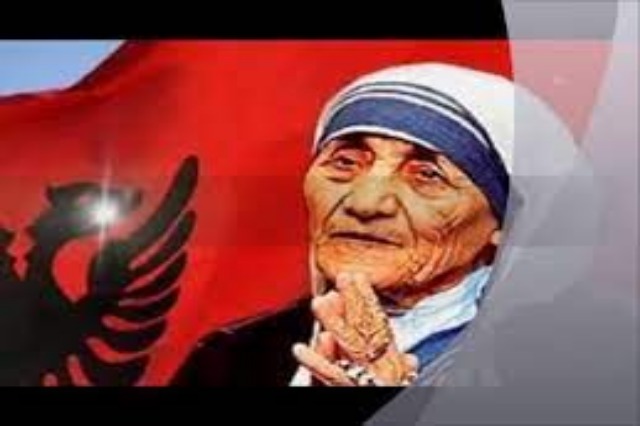
Today is the 112th anniversary of the birth of Mother Teresa, the Nobel laureate and Albanian saint who performed charity for the poor throughout her life. The woman with a big mind and heart who made a whole world love her. Mother Teresa became one of the connecting bridges of the recognition of Albanians in the world.
Anjeza Gonxhe Bojaxhi, known as Mother Teresa, was born in Skopje on August 26, 1910 and died on September 5, 1997 in Calcutta, (India). She was a well-known Albanian humanist, winner of the Nobel Peace Prize, on October 19, 2003 was declared blessed by the Vatican.
Mother Teresa became one of the connecting bridges of the recognition of Albanians in the world. Bill Clinton said in June 2002: “Mother Teresa was the first one who made me love the Albanian nation. And now I feel very proud that I fulfilled a moral duty towards her and towards the values of freedom”. Meanwhile, in 2016, Mother Teresa of Calcutta was declared a saint! The Albanian woman who dedicated her life to the poor, the sick, those whom no one loved anymore, was declared a saint in the Vatican by the Holy Father Pope Francis. The Pope at that time pronounced the canonization formula and registered Mother Teresa as a saint.
Early life
Mother Teresa was born in Skopje, Albania on August 26, 1910. One day after her birth, she was baptized in the Church of the Heart of Christ by the parish priest at the time, Dom Zef Ramaj, a day considered by her as her birthday. Gonxhe Bojaxhi was the third child of Kolë Bojaxhi, originally from Shkodra District, and Drane Bojaxhi (maiden name Barnaj) from Novo Sella of Gjakova. Kola and Drania had 5 children, two of whom died in early childhood. Gonxhe had a brother and a sister. The brother’s name was Lazër Bojaxhi and he studied in Graz, Austria at the Military Academy, but for political reasons he emigrated early to Italy, while his sister’s name was Age Bojaxhi. Her father was engaged in trade and gathered Albanian artists and patriots in his house. Skopje was taken over from Macedonia on January 1, 1918, based on the Treaty of Versailles. Her father, who was involved in the political movements of that time, died in 1919 when she was 8 years old. Gonxhe took her first lessons in an Albanian school in Skopje, where she also finished high school, but in the Serbian-Croatian language.The passions of Gonxhe’s youth were three: to become a teacher, to write and recite poetry, and to compose and play music. She got the name “Teresa” when she was 18 years old and became a nun.
Life as a nun
On September 26, 1928, Mother Teresa left Skopje for Dublin, Ireland. From that day on, mother, daughter and sister would never see each other again. Mother Teresa settled in Calcutta (India) where she first became a teacher and soon the director of a girls’ school. “Mother Teresa of Calcutta” was called when she founded the order “Missionaries of Charity” (1951) to serve the poorest and most hopeless of Calcutta, India and the whole world.
In 1979, when she received the Nobel Peace Prize, the whole world learned that Mother Teresa was Albanian. She had difficulty speaking fluent Albanian after a 70-year absence and living in non-Albanian environments, but she never denied her Albanian origins. Her writings in Albanian are the letters of youth and then with the family in Albanian, greetings in Albanian to the Albanian people after winning the Nobel Prize in 1979 and the prayer in Albanian broadcast by the Voice of America on June 17, 1978. At the moment of receiving the Nobel Prize in 1979, one of the clergy attending the hall asked Mother Teresa where she was from. She stated:
“I was born in Skopje, I was educated in London, I live in Calcutta and I work for all the poor people in the world. My homeland is a small country called Albania”.
The petite Albanian had turned into a living legend. She was the guardian mother of 7,500 children in 60 schools, she was the mother who treated 960,000 sick people in 213 dispensaries, she was the only one in the world who treated 47,000 victims of leprosy in 54 clinics, she took care of 3,400 abandoned old people and left on the streets, in 20 nursing homes, had adopted 160 orphans. These are the figures of the mid-80s. Until Mother Teresa was alive and to this day the numbers have changed a lot.
Former United States President Ronald Reagan awarded Mother Teresa the Medal of Freedom in 1985.
The house of Mother Teresa has been visited by dignitaries such as the Queen of Britain, the former presidents of the United States George Bush and Jimmy Carter, Yasser Arafat, Princess Diana and many others. Mother Teresa was very generous and humane and these are the characteristics that will make her live forever in the hearts of all people, especially in the hearts of Albanians.
When she was young, she not only spoke, but also wrote poetry in the Albanian language. For example, she wrote the following poem when she was 22 years old on her way to India. Today we have a testimony of Mother Teresa speaking Albanian in 1988, in an interview given to the Voice of America in the Albanian language.
The first passport (in this case it was diplomatic) given to a foreign citizen of Albanian origin was given to Mother Teresa, who visited Albania in 1989. Mother Teresa also had passports from India, the Vatican, Great Britain and Italy. When they told her about the Albanian passport, she replied: “I accept it with pleasure, because it is the passport of my country; I have my mother and sister there, I have friends and acquaintances there, very soon we will open our mission there and I will be there myself”. When she received the Nobel Prize in 1979, the Americans offered her American citizenship and a passport, but she refused.
Charity International
Mother Teresa said “By blood, I am Albanian. By nationality, I am Indian. By faith, I am a Catholic nun. According to my profession, I belong to the world. In my heart, I belong completely to the Heart of Jesus.”
In 1982, at the height of the Siege of Beirut, Mother Teresa rescued 37 children trapped in a military hospital by brokering a temporary ceasefire between the Israeli army and Palestinian guerrillas. Accompanied by Red Cross workers, she traveled through the war zone to the destroyed hospital to relocate new patients.
Mother Teresa traveled to help and serve the hungry in Ethiopia, the victims of radiation in Chernobyl, and the victims of the earthquake in Armenia. In 1991, Mother Teresa returned for the first time to her homeland and opened the home of the Missionary Brothers of Charity in Tirana, Albania. By 1996, Mother Teresa was working in 517 missions in more than 100 countries. Over the years, Mother Teresa’s Missionary Charity expanded from twelve to thousands of people serving “with the poor of the poor” in 450 centers around the world. The first Home of the Missionaries of Charity in the United States was established in the South Bronx, New York. Until 1984 the assembly worked in 19 institutions throughout the country. Mother Teresa spoke 5 languages fluently: Bengali, Albanian, Serbian, English and Hindi.
Deterioration of health and Death
Mother Teresa suffered a heart attack in 1983 while visiting Pope John Paul II. After a second attack in 1989, she received an artificial pacemaker. She offered to leave her position as president of the Missionaries of Charity, but the sisters of the assembly, in voted for her to stay. Mother Teresa agreed to continue her work as president of the assembly.
On March 13, 1997, she left the position of president of the Missionaries of Charity. She died on September 5, 1997.
At the time of her death, the Missionaries of Charity of Mother Teresa had over 4,000 sisters, and a brotherhood of 300 members, working in 610 missions in 123 countries. These included hostels and homes for people with HIV/AIDS, leprosy and tuberculosis, soup kitchens, child and family counseling programs, personal assistants, orphanages and schools. The Missionaries of Charity were also helped by co-workers, who numbered over 1 million by 1990.
Mother Teresa was laid to rest in St. Thomas, Calcutta for a week before her funeral in September 1997. She was given a state funeral by the Indian government in gratitude for her service to the poor of all religions in India. Her death was mourned in secular and religious communities. Naëaz Sharif, Pakistan’s prime minister, said she was “a rare and unique individual who lived for a greater purpose.” Her lifelong dedication to caring for the poor, the sick and the unfortunate was one of the highest examples of service to our humanity.” Former UN Secretary-General Javier Pérez de Cuéllar said: “She is the United Nations. She is peace in the world.”
Among the titles given to Mother Teresa are mentioned: Pamada Shir; John XXIII for Peace, which was personally delivered to him by Pope Paul VI; The Good Samaritan, in Boston; The John Kennedy International Award, in Washington; Mother of All Mothers, Balzan; Nobel Peace Prize; the Medal of Freedom, America’s highest award; the Peace Medal, Russia’s highest award; etc.
Hundreds of works have been written and are being written to this day about the great Grandmother Teresa, but all of them tell the truth that she was Albanian, as she herself had declared.
/Klara Ruci/
Të ngjashme
Latest News
Most read




 RTI
RTI