
 English
 Français
 Deutsch
 Italiano
 Turkish
 Greek
 Serbian
Tradition Comes Alive in Gjirokastra’s Stone Streets




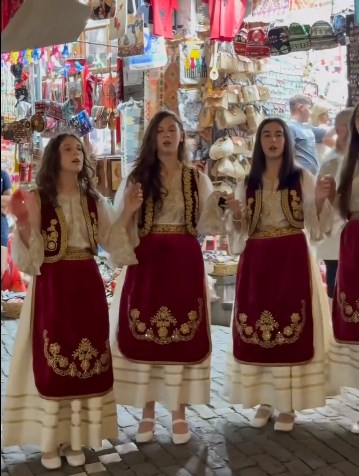
The stone city of Gjirokastra has recorded a significant influx of both domestic and international tourists this year.
Visitors typically begin their exploration at the city’s main attraction—the Gjirokastra Castle—which also serves as the starting point of the city’s museum center.
Minister of Tourism and Environment, Mirela Kumbaro, shared images on social media from Qafa e Pazarit, highlighting how local traditions continue to captivate visitors. She described it as “the place where the traditions of Libohova meet the curious eyes of hundreds of tourists, adding magic to the Gjirokastrian evenings.”
Young women from Libohova, dressed in traditional costumes, animated the stone alleys with energy and color. According to Kumbaro, their presence transformed the streets into an open-air stage, where visitors became part of the celebration.
She emphasized that “our tradition is not merely history—it is a living spirit that inspires generations.”
Gjirokastra’s most visited sites include the traditional Bazaar, the Argjiro Castle, and the iconic homes of the Zekate and Skenduli families. In addition, tourists frequently explore the Viroi Natural Park and cultural heritage sites in surrounding administrative units, such as the Antigonea Archaeological Park and historic religious monuments.
To support tourism, the Municipality of Gjirokastra has organized numerous cultural and artistic events throughout the year. These events promote folk traditions and enhance the city’s cultural identity.
Visitors often express admiration for Gjirokastra’s comprehensive tourism offerings. The city, known for its stone architecture, slate roofs, and white-walled houses, continues to strengthen its position among Albania’s top tourist destinations.
Both local and international groups frequently rank the castle and the Antigonea Park as must-see sites in their guided tours of the area.
/a.c/
Të ngjashme




Latest News










Most read










 RTI