
 English
 Français
 Deutsch
 Italiano
 Turkish
 Greek
 Serbian
Winners of the “Karlspreis” Award in Tirana: A Generational Dialogue on Europe’s 2030 Perspectives




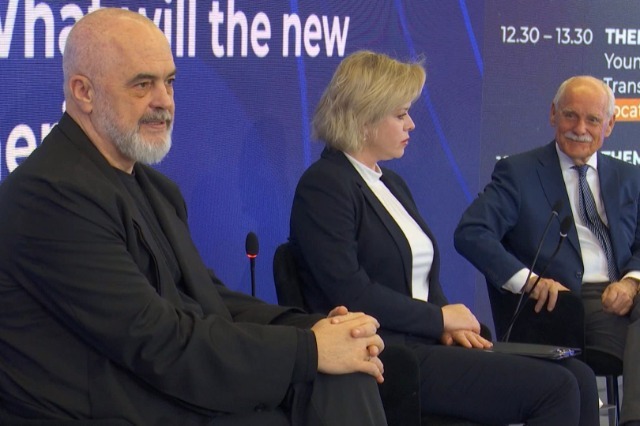
In a landmark event for the Balkan region, the “Karlspreis” Foundation, associated with the prestigious International Charlemagne Prize of Aachen, one of Europe’s highest honors for over seven decades, gathered past award winners alongside young leaders from Albania and across Europe in Tirana.
The Minister of State for Public Administration and Anti-Corruption, Adea Pirdeni, along with the Minister of State for Youth and Children, Bora Muzhaqi, and the National Youth Agency, welcomed the high-level event “NextGEN Voices for Europe,” focused on youth and European cooperation. The event was organized in collaboration with the Karlspreis Youth Foundation.
Since its establishment in 1950, the Karlspreis has been awarded to individuals and institutions that have made significant contributions to the unification and progress of Europe, including historical figures such as Winston Churchill, Jean Monnet, Robert Schuman, and Henry Kissinger.
The prize is named after Charlemagne, who ruled much of Western Europe and was crowned Emperor in Rome in 800. He played a pivotal role in shaping European history.
Over the years, the prize has been awarded to influential figures including Ukrainian President Volodymyr Zelensky, French President Emmanuel Macron, former U.S. President Bill Clinton, former German Chancellor Angela Merkel, former British Prime Minister Tony Blair, and Pope Francis.
Prime Minister Edi Rama, along with the two “Karlspreis” laureates, Martin Schulz (former President of the European Parliament) and Veronika Tsepkalo (Belarusian opposition representative), and Dr. Jürgen Linden, Chair of the Board of the International Charlemagne Prize, welcomed the “Karlspreis” Youth Prize winners and young Albanians to engage in an open and in-depth dialogue on Europe’s future in 2030.
Beyond intellectual discussions, the “NextGEN Voices for Europe” event also offered a rich cultural experience, showcasing Albania’s historical heritage and its European aspirations.
Attendees had the opportunity to explore Albania’s rich cultural legacy through visits to the historic centers of Kruja and Durrës, offering an authentic experience that highlighted the country’s history, traditions, and its deep connection to European values.
/a.p./
Të ngjashme
Latest News










Most read










 RTI