
 English
 Français
  Deutsch
 Italiano
 Turkish
 Greek
Greek Serbian
Writer Fatos Kongoli celebrates his 80th birthday anniversary




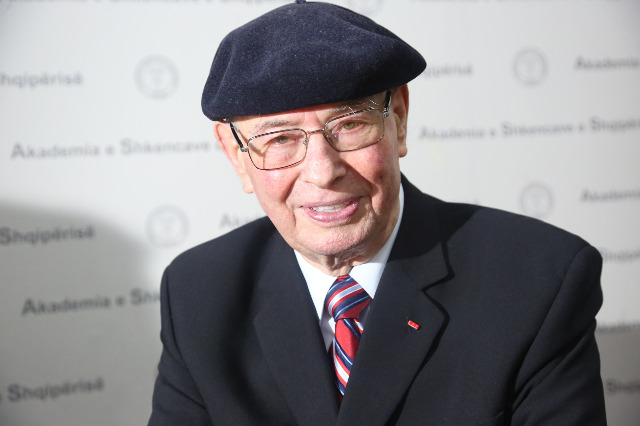
The renowned Albanian writer and member of the Academy of Sciences, Fatos Kongoli, celebrated his 80th birthday among friends, relatives, and readers at the Academy of Sciences.
In his honor, an event was organized by ‘Toena’ Publications and the Academy of Sciences of Albania. The celebration of the writer’s 80th anniversary included the participation of distinguished figures from Albanian literature and politics. When questioned about his prolific creativity by high school students in Tirana, the writer candidly shared his passion for writing.
Fatos Kongoli has been honored with the ‘Silver Pen’ award three times for the best book in prose, along with various other accolades both at home and abroad. He holds the distinguished title of ‘Knight of the Legion of Honor,’ bestowed by the President of France, and ‘Grand Master,’ conferred upon him by the President of the Republic of Albania.
The President of the Academy of Sciences, Skënder Gjinushi, hosted a special reception for him, attended by academics such as Vasil Tole, Neritan Ceka, Shaban Sinani, Floresha Dado, Mimoza Hafizi, Dhimitër Haxhimihali, Gëzim Hoxha, and Toena publishers Irena and Fatmir Toci.
During this event, they welcomed Professor Shaban Sinani, the publisher Irena Toçi, the director of the KKLL, Alda Bardhyli, as well as writers Namik Dokle, Xhevahir Spahiu, Besnik Mustafaj, and Behar Gjoka.
Kongoli has been described by critics as a transitional writer, dedicating his entire body of work to Albania over three decades of democracy.
The academic secretary, Shaban Sinani, spoke on behalf of the Presidency of the Academy of Sciences. In his speech, Shabani emphasized, ‘Fatos Kongoli is a special personality, closely linked with a literary-cultural era, the era of the writer in freedom. He represents a writer who possesses the ability to make a distinct and qualitative difference, not only from a bygone era but also from his former self.
Writers who emerged from a society characterized by ideological, cultural, and religious control, collectively representing a generation that Robert Elsie termed ‘the post-Kadare generation,’ found themselves enthusiastic as citizens for the changes during the transitional period. However, adapting to the fall of literary canons wasn’t as straightforward. Figures like Fatos Kongoli, Zija Çela, Koço Kosta, Xhevahir Spahiu, Bardhyl Londo, and Skënder Rusi stood out as among the few ‘challengers of freedom.’ They did not give up; on the contrary, they continued, with some adjustments but steadfast determination, to pursue literature with a heroic passion. This was in contrast to many others who either remained silent or were compelled to alter their expressive registers.
Within this group, Fatos Kongoli merits recognition for ‘parting with a bitter laugh’ from the past and embarking on a distinct path. Rather than externally trying the past, he engages in self-reproach and self-irony within his literature. This approach is triggered by the world within the man, within the author—gaining insights into the intricacies of one’s own life, particularly the vices and wickedness. Kongoli invites the reader to detach from these aspects through a sense of disgust.
The critical and ruthless self-discovery, expressing a remarkably high level of emancipatory mentality, is one of the reasons Fatos Kongoli’s literature, comprising about 20 novels and volumes of stories, has been translated, published, and republished in numerous languages worldwide. This includes translations in France and Italy, Switzerland, Greece, and Germany, as well as in Great Britain and Spain. His works have reached readers in Serbia, Slovenia, Slovakia, Japan, China, and even in ‘the linguistic invention of Dr. Esperanto.
His achievements give us pleasure as it affirms that in the ranks of academic writers, we now have another internationally recognized author, Fatos Kongoli. He stands alongside Ismail Kadare, who ‘crossed the border’ from the very beginning, as a ‘fugitive in mind,’ and Luan Starova, who comfortably resides between three literatures, engaging readers across two continents.
The work of Fatos Kongoli has captured the attention and emotions of both Albanian and foreign readers, thanks to its poignant portrayal of the life of the Albanian people during two distinct periods: the dictatorship and the transitional era. His work delves into the individual’s confrontation with the absurdity of life, internal dramas, and a deep exploration of the human psyche with repressed thoughts and feelings. Kongoli’s fundamental creative innovation lies in the creation of anti-heroes, not as a conventional counterpoint to the previous hero cult, but as an opportunity to delve into the shocking unknowns of human existence.
It was precisely due to this unique self-exaltation that, two years ago, the Nobel Committee approached the Academy of Sciences with a special request. Unlike the usual practice of presenting one candidate, the Committee asked for four proposals, as part of a new procedure involving cooperation with all the academies invited that year. When the special invitation arrived to recommend worthy candidates for the most prestigious literary prize on a global scale, the Albanian Society of Writers and Artists argued and, among its choices forwarded to the Royal Academy of Sweden, included the candidacy of the writer-academic Fatos Kongoli.
In adherence to the Nobel Committee’s rigorous and codified correspondence protocol for nominations, confidentiality had to be upheld until the conclusion of that year’s competition. Due to this bureaucratic constraint, our friend and colleague Fatos Kongoli, along with the public, remained unaware of this high institutional evaluation until today. Now, with the expiration of the confidentiality period, we can officially confirm and share this prestigious acknowledgment.
As part of the Academy of Sciences policy, there is a principled choice to evaluate and propose the most outstanding personalities in the fields of knowledge and creativity whenever invitations are extended to internationally promote figures of science and national culture. This approach ensures that there are no gaps in the recommendations. The Academy of Sciences has submitted proposals for prestigious awards such as the ‘ Feltrinelli’ award, the ‘ Madame de Stael’ award, and for scientific research evaluators of the ‘European Research Area’ (ERA). While not always winning, these proposals have often been well-received by juries of international commissions, and the recognition in scientific and creative environments continues to expand. Similar efforts were undertaken in the case of the invitation from the Nobel committee. Alongside the annual proposal for Ismail Kadare, supported not only by Academy of Sciences but also by other academies, the candidacies of Fatos Kongoli, Luan Starova, and Carmine Abate, a current phenomenon in Italian literature, were also registered that year.
In the argument for Fatos Kongoli’s candidacy, it is stated that the axis of all his creativity revolves around the existential crisis of man as an individual and a collective being. His works explore human paradoxes, the irony of past realities, and absurd situations with the aim of inducing an identity crisis. Despite not being steeped in optimism, his literature is not harsh. On the contrary, it delves into the secrets of the human soul, revealing the essence of humanity and human love, which, according to the author, serves as salvation for mankind in all times. The doubly dark recesses of the human mind, influenced by the complexes of general psychoses and personal weaknesses, as depicted in his novels, have led the French press to describe them as a combination of the writing techniques of Dostoyevsky and Beckett. Kongoli’s novels offer hope and encouragement for the perspective of modern Albanian prose. In contrast to a vicious Balkan tradition of rejecting neighbors, including those beyond linguistic borders, he was quickly embraced as a worthy friend in the literatures of the region, extending to Bulgaria, Romania, Turkey, and Greece.
Former President of France, Nicolas Sarkozy, presented Fatos Kongoli with the ‘Knight of the Legion of Honor,’ stating, ‘My country recognizes, in every sense of the word, the greatness of your work. Transforming an act of suffering and loneliness into literature is a formidable task.’
The Academy of Sciences is putting forward Fatos Kongoli as a nominee for the highest literary honor, not just as a representative of Congo but also acknowledging his international stature. President Sarkozy mentioned on the same occasion:
Considering the rich content and novel experimentation displayed in his works, I strongly recommend to you, esteemed members of the Nobel Committee, to give special consideration to the literature of the Albanian writer Fatos Kongoli.
In 2022, the President of the Academy of Sciences, Acad. Skënder Gjinushi, wrote a letter to the Swedish Academy of Sciences on behalf of the Presidency. The purpose was to nominate Acad. Fatos Kongoli, a writer with national and international recognition, as a candidate for the Nobel Prize.
/m.ll/
Të ngjashme
Latest News
Most read








 RTI
RTI