
 English
 Français
 Deutsch
 Italiano
 Turkish
 Greek
 Serbian
Zef Mazi: France’s reasons for not separating Albania from North Macedonia on the road to the EU!




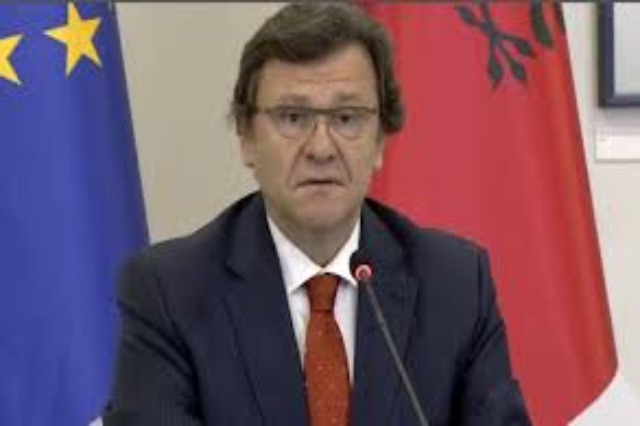
Interview with Zef Mazi, Chief Negotiator of Albania for EU Integration
Question: In an interview with Euronews Albania, the Ambassador of France in our country said that “in the integration process Albania can not be separated from North Macedonia. “The idea that countries can be segregated must be overcome.” What is your comment?
Answer: France, which has just taken over the Presidency of the European Council, has set its priorities as the next President. We hope that enlargement will be high on the agenda of this Presidency. We wish success to the French Presidency of the EU.
In the priorities presented by the President of France, it does not seem that the integration of the current candidates is mentioned. It is only a conference on Balkan regional cooperation. I am not able at the moment to unravel what is meant by it, whether it is complementary to integration or instead, the idea remains unclear.
Meanwhile, it speaks of increasing EU autonomy as a possible new mechanism. It is unclear how this will stand, broken down into details of the content, how far it goes, what it includes in relation to NATO.
There are many elements in those priorities that need to be carefully and slowly analyzed, to be discussed among member states, to reach a common consensual denominator of 27 members.
Regarding the interview, I can say that the ambassadors act with instructions from their centers. Integration is a process that lasts for years, even decades, until the membership of the candidates. I do not understand on what legal, legislative, EU directive or other basis the position of “separation / non-separation” of countries like Albania and North Macedonia is based upon!
It is clear that in the EU, there are member states that are not enthusiastic about integration, about bringing new members into the EU. The rhetoric repeated over the years must now give way to works that we are not yet seeing. Albania has met all the requirements and criteria to start technical negotiations with the First Intergovernmental Conference. For this point, for Albania, as far as I know, and I believe I am correct, it has the unanimity of the 27 member states, including Bulgaria. There is no unanimity for North Macedonia from the 27 countries. This is a political problem.
The EU itself must do what is possible to achieve the unanimity of the 27 states for North Macedonia. This effort, until the stalemate is resolved – which may take a long time – should not hinder Albania’s progress. Integration must continue. It is a big strategic mistake of the EU if the process stops. Credibility, rhetoric about integration, would be significantly devalued.
Question: Why do you specifically insist that France, referring to this interview, but also beyond it, does not separate Albania from North Macedonia, when Albania has met the requirements and criteria?
Answer: France should be asked about this. We are in a real world. Everyone understands well. It is time to give clear thoughts, without semantic embellishments. I do not want to avoid giving my opinion. Albania has come a long way, has made a lot of progress in the future, without stopping. It pursues all reforms intensively. It has been officially stated, institutionally, in writing, by the EC, that Albania has met all the requirements.
I am aware, I hope correctly, that the idea of non-separation was first used by a member state, when Bulgaria and Romania were getting ready to join. One of them was ahead of the other. To ensure that one country did not lag behind for a long, indefinite period, that member country insisted that the two candidates shouldn’t be not separated, but join the European Union together. This attitude marked the precedent of using “separation” and “non-separation”.
I underline that I do not know of any document, decision or directive, or anything else, unanimously approved, officially, in the European Council, to request the integration or inclusion of candidates in the group! If true, this would be a major change in the EU enlargement itself: enlargement is based on individual (candidate) merit. Neither more nor less. Otherwise, this basic principle of EU enlargement would suffer a major erosion. Enlargement would no doubt be seen as not insignificant. The EU must state clearly, with legal arguments, like the Council, to be credible on this point. How do the people and the candidate countries think about these fluctuations, attitudes?
I repeat, it is obvious that today there does not seem to be an appetite from everyone for enlargement. Some do not like the process. The reasons are different. Some have choices on the horizon. For them, this is the preoccupation, the number one priority. The whole administration seems to work in their function.
In the EU it is noticed that there are leadership efforts; there are problems with the perspective and interpretation of the rule of law, EU legislation in relation to the national constitution, migration, budget, etc. It is not excluded that any member might be hidden behind “non-separation” for one or more of the above reasons.
Ideally, Albania and North Macedonia should both sit at the table of the First Intergovernmental Conference earlier. The situation is not the best. Our Prime Minister made it clear that if the stalemate continues unresolved, we will consult with the people and seek separation from North Macedonia.
This is a completely legitimate step, a completely legally and politically justifiable request. I can only hope that we can get a date for the Conference. We will continue the work, however, having in mind not to slow down the pace of work, to continue the reforms for the good of our country and people, by doing patience, patience!
/Klara Ruci/
Të ngjashme

Latest News
American magazine highlights Albania’s Peaks of the Balkans trail
Most read










 RTI