
 English
 Français
 Deutsch
 Italiano
 Turkish
 Greek
 Serbian
“Man and Movement” – Gjon Mili’s photographic exhibition




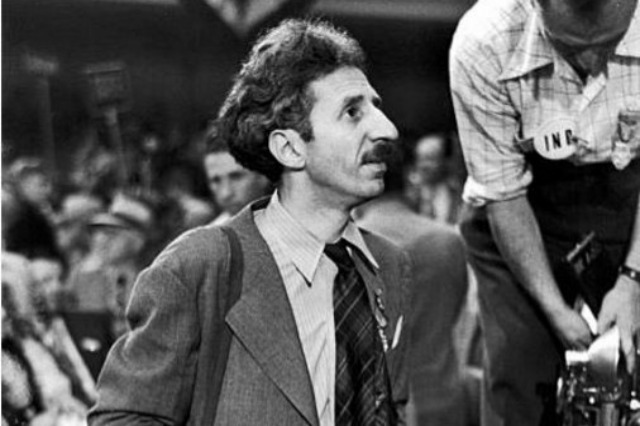
A photographer who has been recognized for four decades as a master at capturing the essence of motion is now exhibiting his career highlights at the Washburn Gallery at the Boston Museum of Science.
Gjon Mili, born in Albania and the first photographer for Life magazine for 34 of its 36 years, uses to its limits the extraordinary ability of a stroboscopic flash to crystallize the flow of movement into a sharp, which takes your breath away. Captured by a flash of light that lasts only a fraction of a second, figure skaters, athletes and ordinary people in motion show all the unconscious grace of the human body.
Milli spent his childhood in southern Romania and came to the United States in 1923 to attend the Massachusetts Institute of Technology, where he majored in electrical engineering. He continued his higher studies at Westinghouse Electric and Manufacturing Company and then became a research engineer at Westinghouse Lamp Division.
As Milli’s fascination with the possibilities of stroboscopic photography grew, he devoted more and more time to perfecting his procedures and skill. In 1938, photography became his full-time occupation. He cites his long association at M.I.T. with Professor Harold E. Edgerton, whom he met in 1937 and credits as a major motivating force in his career.
Milli uses a variety of techniques to produce his breathtaking photographs. Using a single flash of light from the strobe, he is able to freeze a moment of movement on his film. Using a flash and multiple exposures, Milli records a series of movements that combine to make a single “full motion.”
Another approach that has produced interesting effects for Milli is to photograph a stationary subject while positioning the camera across it. The repeated image parading across the resulting photograph gives an effective sense of symmetry.
In his movement study, Milli has turned his camera on participants in all the performing arts, and a list of his subjects reads like a who’s who. But he didn’t limit himself to the theater—a 1973 assignment from Time, Inc. took him to the Theater. Watergate hearings, where he spent four months and used nearly 200 films photographing witnesses.
Some of the unusual pictures that came out of this assignment can be seen in “Life’s The year in pictures” — 1973.
In all his work, Milli seeks to capture with his camera moments too fleeting for the human eye. The exhibition at the Science Museum, entitled “Man and Movement”, gives us an intriguing look at these scenes. The photographs will remain in the Museum until March 31.
/k.s/
Të ngjashme



Latest News




Albania inspects Kanina Castle as conservation work continues

Most read










 RTI