
 English
 Français
 Deutsch
 Italiano
 Turkish
 Greek
 Serbian
Anthropologists and Historians Revisit Albania’s 1968 Transformation




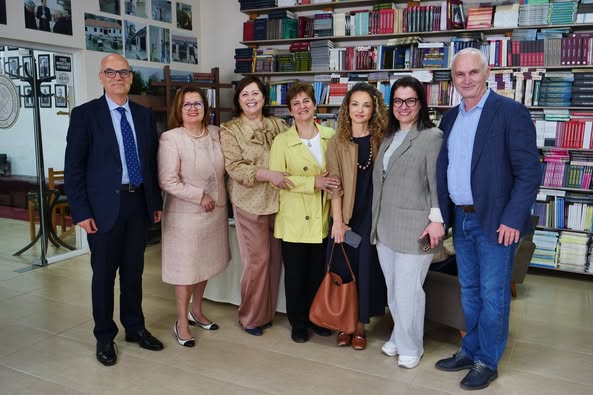
The Academy of Sciences held the symposium “The 1968 Movement for the Revolutionization of Life in Albania.” Several institutions organized the event. These included the Section of Social and Albanological Sciences, the Permanent Commission of Anthropology and Cultural Heritage, the Department of Political Sciences at the University of Tirana, and the Authority for Information on Former State Security Files (AIDSSH).
The symposium focused on the impact of the 1968 movement in Albania. It also examined how the Chinese Cultural Revolution influenced the country. Moreover, scholars presented new research and case studies.
First, academician Gëzim Hoxha welcomed the participants. He praised the symposium’s topics and emphasized their scientific value.
Then, academician Albert Doja spoke as head of the new Anthropology and Heritage Commission. He noted this was their first event. He thanked author Albert Nikolla for the idea and for helping expand anthropological perspectives.
Next, Professor Enika Abazi gave the opening lecture. She explained how the communist regime used culture as a tool. The state reshaped identity to match Marxist-Leninist ideology.
Afterward, Associate Professor Klodiana Beshku and Assistant Professor Klejd Këlliçi discussed feminism. They compared the second wave of feminism in the West with Albania’s version of “emancipation as sacrifice.”
Later, Associate Professor Albert Nikolla analyzed Albania’s imitation of the Chinese Cultural Revolution. He focused on the destruction of the Catholic Church. He also showed how state documents revealed hostility toward religion. In addition, he presented a case study from Hajmel, a village in Shkodra. His research used a 1967 publication. In it, citizens wrote to Enver Hoxha to report actions against churches and priests. According to Nikolla, Hoxha’s works gave people instructions on how to behave under socialism.
Following this, Associate Professor Majlinda Keta spoke about the “new socialist man.” She compared this ideal to real individuals in post-communist Albania during the 1990s.
Finally, Elona Baçi presented documents from the state archives. She focused on the 11th Song Festival. She highlighted the case of Sherif Merdani, a singer jailed for performing music considered too modern.
In conclusion, the symposium offered fresh insights. It opened new ways to study Albania’s past through history, politics, and anthropology.
/a.c/
Të ngjashme

Latest News


Most read










 RTI