
 English
 Français
 Deutsch
 Italiano
 Turkish
 Greek
 Serbian
Puka Dance and Traditional Costumes




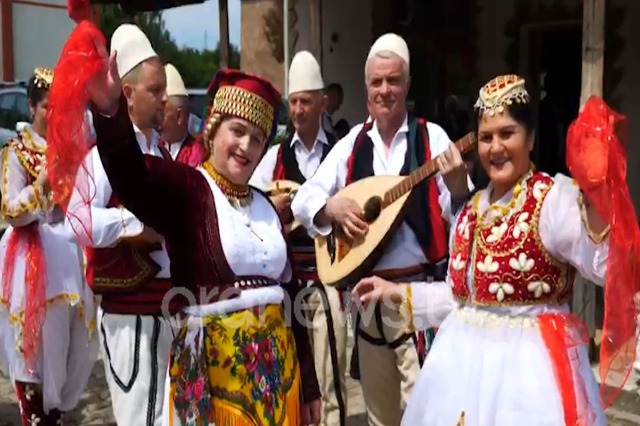
The distinctive dances of Puka, much like those found throughout our country, are a product of historical and social circumstances that have influenced the ethnographic communities within the Puka region.
Foremost among these dances is the epic Kabashi dance, often referred to as the Kabashishte dance, according to popular oral tradition. Evolving over centuries to reflect the aspirations and customs of the highland dwellers, this dance has undergone various adaptations, sometimes simplifying, sometimes incorporating new movements.
Kabashi, serving as a focal point of historical, economic, and spiritual significance, has been instrumental in both preserving and innovating dance traditions in the region. Hence, it’s no coincidence that this dance, performed beyond Kabashi throughout our homeland, is dubbed “The Dance of Kabashi.”
The Dance of Kabashi is a robust, age-old form of dance falling under the category of vigorous dances. Its antiquity is evident, and given Kabashi’s historical role in the Puka region and its pervasive influence across material and spiritual domains in the vicinity, it has remained cherished tradition throughout.
This dance typically involves four male participants forming a closed circle, standing proudly facing each other. According to oral tradition, these four dancers symbolize the four brotherhoods of the Kabashi kinsman. Their dynamic movements and pronounced rhythms imbue the dance with expressiveness and intrigue. The choreography revolves around three primary elements: the expansive arm movements, the emphatic foot stomping, and the bold leaps forward.
The expansive arm movements reflect elements of Albanian dance, a hallmark of its beauty. The emphatic foot stomping, on the other hand, harkens back to ancient traditional rhythms, symbolizing the connection between our people and the land, invoking strength and courage with each step.
These three fundamental elements of the Kabashi dance blend seamlessly, creating a cohesive whole that resonates with the joy of life, the unity of the people, and their resolve to confront any adversity.
Over time, the number of dancers participating in the Kabashi dance has diminished, particularly in villages like Kabash, Qerret, Puka, Micoj, Meçe, Buhot, Rrape, Kryezi, and Iballe. However, this decline has given rise to variations, such as the epic-lyrical and lyrical variants, which feature two male dancers or mixed genders. These variants are now prevalent throughout the region.
The traditional attire worn by dancers is emblematic of the Puka region’s culture. It includes calf leather boots adorned with braids and tassels, woolen socks embellished with gold or silver threads, and a wide leather belt intricately woven with colorful threads.
The dancers also used to wear a white shirt with embroidered collars and a “Gjakova Vest” embroidered with silver or gold threads over it.
The Dance of Kabashi is performed on various occasions, including weddings, fairs, folk festivals, family gatherings, and commemorations, adding vibrancy and cultural richness to these events.
/k.s/
Të ngjashme


Latest News





Most read










 RTI