
 English
 Français
 Deutsch
 Italiano
 Turkish
 Greek
 Serbian
Mati traditional clothing




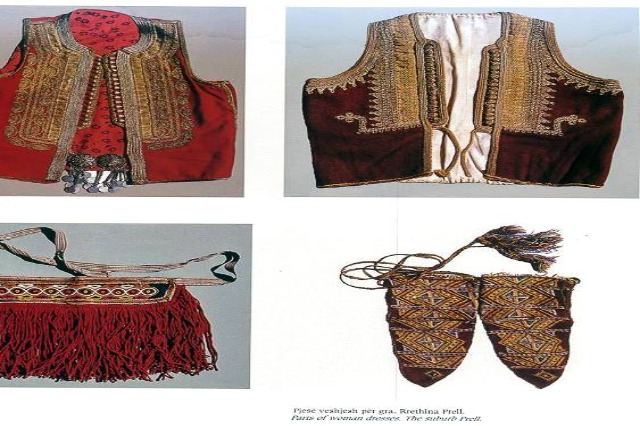
Folk costumes express a national identity through clothing, which is usually associated with a specific region or period of time in history. This fact is also fully visible in Mati’s traditional clothing, which has an incredible range of varieties. The history of this region is written in them.
Mati is one of the areas rich in folk clothing. In particular, women’s clothing is quite diverse in types and variants. In addition, they stand out, also for the vibrancy of the colors used in their decorations. Red and yellow colors are especially preferred.
According to the definition made by local residents, the variants used in different villages are summarized in three groups: “white dress” which means the costume worn by the women of Catholic villages, “black dress” is the costume worn by a group of villages to the left of the Mati Valley, where the process of converting the population in Muslim has occurred more quickly, the “Matian dress” (which is even more widespread) means several variants that have been kept in most of the villages of the district of Mati.
In general, the long and wide white (two-piece) shirt stands out in the clothing of Mati’s region. In addition, the women’s head covering in all the neighborhoods is white (with the exception of the village of Gur i Bardhë), but the form and the way it is tied changes from one neighborhood to another. More or less the same as the apron made of cotton fabric and decorated with red, yellow and white stripes. It is a question of a type of apron which is used not only in the villages of Mat district but also in some villages of Kurbin, Kruja and Dibra.
Another common element is the colorful socks, with an interesting composition of motifs and colors. Meanwhile, in these clothes, there are many other parts that make up the distinguishing features of each region.
Clothing with the most characteristic features is the one worn in the village of Macukull. The distinctive features of this village’s clothing are the shajak (woolen)sweater and wide stockings like those of Mirdita. While the most distinctive feature is the way the head scarf is tied. From the way it was modeled and tied on the head, it resembles a diadem made of cotton cloth.
Although the variants used from one village to another belong to the type of clothing with a long shirt, the differences are presented in the ornaments and the way the head scarf is tied. Somewhere they are plain (orange or yellow), accompanied by a waistcoat decorated with artificial sequins, elsewhere sewn with a piece of cotton, decorated with black and yellow stripes as well as with black thread.
It is here that the classic type of long dress is found, made of white cotton fabric, decorated with thin black stripes. The most interesting element in this outfit, which is unique, is a type of belt called a “glamorous belt“. This belt was created by joining 33 braids in the form of thinly spun cherry-colored woolen threads.
It is noted that in Guri Bardhe clothing, some elements of the past have been preserved, such as the shape of the sleeves, various ornaments, etc. In general, this clothing appears quite luxurious, its parts are made of expensive material, which constantly came from the markets of oriental countries. A few parts stand out more, one called gerzhanez (it has a front open shape) the waistcoat, all decorated with gold thread strings, the belt accompanied by a silver chain.
Their sewing was usually done by craftsmen specialized specifically for these types of clothing. Adding to the luxury of the various parts are the numerous ornaments made of gold, unlike those of other rural surroundings which were usually made of silver. The winter outfit also included a black jacket decorated with red thread.

/k.s/
Të ngjashme

Latest News




Most read










 RTI