
 English
 Français
 Deutsch
 Italiano
 Turkish
 Greek
 Serbian
Radio Tirana celebrates its 85th anniversary




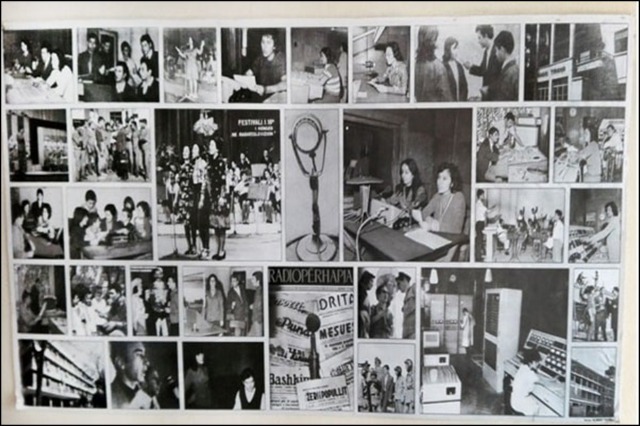
“Ju flet Tirana!” /This is Radio Tirana!/- This was call from November 28, 1938 until today, coming from a radio set, reminding us that it is the first radio in the country that laid the foundations and built the history of the radio in Albania.
Radio Tirana, for the first time in its history, started broadcasting on November 28, 1938, five months before the invasion of Albania by fascist Italy.
The news about the opening of a radio station in the Albanian capital, where Albanian music could be spoken and broadcast was received with great enthusiasm by the people.
In King Zog I Tirana, the idea of a radio was among the great chances of spreading an emancipatory spirit for the inherited backwardness of the Albanian society. Evidence shows that in the inauguration ceremony of Radio Tirana, King Zog I and Queen Geraldine themselves participated, who also gave the relevant speeches.
The first director of Radio Tirana was appointed Gjergj Bubani. He had come in the mid-1930s from Romania, where he had been noted for his patriotic activity, especially in the field of journalism. And the reason why Zog I proposed him for this task was the fact that he was the biggest critic of why Albania did not have a Radio Theater.
Gjergj Bubani, equipped with a wide culture and knowledgeable of four foreign languages (Romanian, Greek, Italian, French), played an important role in raising the quality of Radio Tirana’s broadcasts, which was taking its first and difficult steps, and was gaining the features of a national radio station.
From this radio, patriotic and popular Albanian music was first broadcast and mainly thanks to gramophone records donated by the citizens, which were used initially. The programs were filled with songs, radio chronicles, but also songs from Paris, Romania, so not only folk music but classical music too.
The opening of Radio Tirana was a kind of a climax due to the fact that it came at a moment when Albania and the capital itself were marking an opening, a development in terms of urbanization and the establishment of relations with neighbors, and also due to the fact that Albania could not be outside the technological developments of time, thus it would have its own media in 1938.
In addition to the informative character, Radio Tirana also made a combination of Albanian art and culture and international music. The magazine “Radio Tirana” /the main news/ itself presented its program schedule in English and Italian too.
Gjergj Bubani started to promote ethnic Albanian musical culture, collecting all the recordings from north to south and broadcasting them on Radio Tirana which was becoming a major mainstream media. Southern jazz, Shkodra music and the band of Central Albania were heard there. So there were these 3 main musical formations. What constitutes innovation at this time was live music. It was broadcast naturally live. So the music broadcast was with records, but also live with folk music.
The first orchestra was founded, which at that time was called modern and played light music. A class of musicians trained in the best schools in Europe was created, Tetfta Tashko Koco, Jorgjie Truja, Marie Kraja, Lola Gjoka as a pianist, Tonin Guraziu as a pianist, Mihal Ciko, Kristaq Antoniu who offered Radio Tirana a western flavor until in the Liberation of Albania.
Gjergj Bubani created the group of actors for the shows Hilarious Hour, Children’s Hour, Archaeological Conversation, Countryside Hour – shows about agriculture, and health advice from doctor Sulçebe. The creation of the first Fonoteca began with recorded discs of Beethoven’s music, thus fiving to Radio Tirana another dimension. So Radio Tirana took the form of one of the most important institutions in the country.
At the time when Albania was being invaded by fascist Italy, on April 7, 1939, calls were made everywhere for the people to rise up against this invasion. The call that came from Radio Tirana made a big echo. The director of Radio Tirana himself, Gjergj Bubani, appealed to the world in several foreign languages ”Save Albania because it is being invaded by fascist Italy”.
From the end of 1939, Radio Tirana was transferred as a building and starting from 1940, it started to publish a bi-weekly magazine, which was first called “Radioprogram”, then “Radiorevista Tirana” and “Albanian Fireplace”.
With the Nazi occupation (1943), the radio fell into the hands of the Nazis and it took only few weeks, that of November 17, 1944, to liberate Tirana and to recover the radio that belonged to it.
Until 1944, there were 8 hours of program.
On November 27, 1944, Radio Tirana resumed its tradition. Partisan music followed, folk music, music performed by the artists present in the studio, accompanied by the Italian pianist Mario Etore and the Albanian Lola Gjoka. Every night was like a premiere. Artists coming and going, live emotions, loudspeakers placed in the most key points of the capital and crowds of people listening through them.
Lyric singers who debuted after the WWII were Tefta Tashko Koço, Kristaq Antoniu, Marie Kraja, and many others. After that, programs started with patriotic songs, reports from the railways under construction, from the life in the city, the programs “Women’s Hour”, “Children’s Hour”, “Peasant’s Hour”, “Joyful Hour”, “Medical Advice”, etc. started or restarted. Since the first days after the war, Radio Tirana has broadcast news in foreign languages, continuing the experience started in April 1939.
In 1945, Radio Tirana started for the first time in its history, a series of sports broadcasts, where Anton Mazreku became its protagonist. In 1946, the dramatization of various parts began, with the participation of the best actors of the Albanian scene.
January 9, 1946 marks the beginning of Radio Tirana’s programs at 6:00 p.m. One of the new programs with which Radio Tirana was enriched in the first days of 1945 was the live connections from the Officers’ House first and then from Hotel Dajti to broadcast music.
January 1947 would bring other changes in the programs of Radio Tirana. Until then, musical pieces, speeches and even reports were recorded on soft discs (deciliter). The well-known Italian engineer, Antonio Galeazi, who, together with the pianist Mario Etore stayed in Albania until 1948, providing tangible help in the development of Radio Tirana, with the technical development.
Throughout 1950, Radio Tirana’s programs did not experience any significant changes.
On June 15, 1952, Radio Tirana made an obvious quality step, broadcasting four shows a week for children.
An important event during 1957 was the start of the second program of Radio Tirana, a necessary need to give more space to the listeners. In the 50s and 60s, according to a report in the RTSH Archive, the ratio was 40% programs and talk shows and 60% music. The cultivated Albanian music recorded by Radio Tirana was still in its first steps.
The breakdown of relations with the Soviet Union, in December 1961, led to the termination of many agreements and projects, among which was the construction of the new building of Radio Tirana and the large Palace of Culture. Then both of these important facilities were decided to be built with only by own forces, by decision of the Central Committee of the ALP. This was one of the challenges that the Labor Party made to the Soviet state.
Since 1961, after the breakdown of relations with the Soviet Union, Foreign Radio, which until then had only broadcast programs in six foreign languages; Greek, Serbo-Croatian, Italian, French, English and Arabic, had also started broadcasting in Russian, Bulgarian, German and then would start shows in Czech, Hungarian, to continue in other languages, such as Polish, Portuguese, Spanish. The new Radio Tirana building provided for, although, over the years, even these studios became insufficient, because other languages were added, such as Indonesian, Turkish, Swedish, Persian, Chinese, and even Swedish, so that the voice of the Party and the dictator, Enver Hoxha, could be spread across the globe and inspire all the peoples of the world to fight against imperialist-revisionist exploitation, as it was the propaganda of the day.
The RTSH Symphony Orchestra was founded on May 16, 1962 as the largest orchestral formation of the time. The orchestrators were mainly young musicians, who studied in the country, but also were specialized abroad like Prague, Moscow, Leipzig and several different countries in Europe. Initially it was called “Symphonic Orchestra of Radio and Cinematography” and then “Symphonic Orchestra of Albanian Radio and Television”.
The purpose of creating this musical formation first at Radio-Tirana and then within the institution of RTSH was to provide and cover hours of music broadcasts, enabling the realization of many artistic activities that this institution conceived and implemented.
The creation of the orchestra marked a new stage in the country’s cultural and artistic development. The founder of this orchestra was Abdulla Grimçi. The first concert was performed on August 20, 1962 under the direction of Mustafa Krantja and works by Haydn, Mozart and Mendelssohn were played. The violin concerto in E-minor was the first time performed by 17-year-old Ibrahim Madhi.
The creation of this great musical formation brought an extraordinary, significant and immediate impact on the musical development of the whole country, taking forward steps in the general cultural development.
December 1962 would mark a great event not only for Radio Tirana but for artistic life in our country in general. The first Light Song Festival on the Radio, which continues its tradition even owadays, took place in December 1962. The initiators of this festival were the head of the music editorial office, Abdulla Grimçi, and the editor of the same editorial office, Vath Çangu, who was at the same time a composer and song writer. The event set in motion many composers who presented 48 songs.
In 1965, Radio Tirana started broadcasts in the new building. During this period, Radio Tirana had actually taken on the appearance of a modern radio in the full sense of the word.
In general, the Radio broadcasts of this period, as well as our entire press, served the propaganda of the Labor Party, by “highlighting the great achievements of the people” in the “new socialist society”, although from the professional side they were adapting to the nature of the radio where the word alive, free and flexible should sound as natural as possible.
During 1966, two young journalists started working at Radio Tirana, who gave a significant boost to radio news. These were Alfons Gurashi and Agron Çobani who started as radio reporters for political, economic and social problems in the newsroom. Thus in 1966, thanks to these two journalists, the school of Albanian radio reporting was created.
The year 1970 brings into the hands of the Albanian reader the magazine Radioperhapja /Radio Spred/, which began to publish radio and television programs.
Radio Tirana turned into a great producer and transmitter. Its audio library preserves rare values for the history of Albanian music and the people who worked there built everything with their own mind and hands.
In 1972, with the beginning of the liberalization of life in the country, at the time when a breeze of change seemed to be blowing, Radio Tirana started the “Music Review” and tried introducing foreign music, such as “The Beatles”. It was the time after the 11th Festival in RTSH, a political refrain, which caused sensitive disputes, reactions and objections.
Everything liberalizing that had begun to flourish was interrupted in the midway and Radio Tirana continued with its propaganda ritual.
In the 1980s, the second channel started broadcasting again. It is remembered for the beautiful songs of Julio Iglesias or Modern Talking, Mireille Matie, Demis Rusos and many music stars, which were broadcast on the summer days.
The wind of change brought more freedom for journalists, but also more space and truth for the listeners, who saw RTSH as the only means of information about the violent events that accompanied Albania.
The 1990s found Radio Tirana with almost the same staff. The wind of change brought more freedom for journalists, but also more space and truth for the listeners, who saw RTSH as the only media of information about the violent events that accompanied Albania.
Radio Tirana is a witness, but also a protagonist of Albanian history. It is its employees, all passionate, courageous and professional people, all in love with the radio and its fascination, who today inspire the listeners of Radio Tirana, raising its name as the temple of culture and human emancipation.
/RTI Editorial Office/
Të ngjashme
Latest News

Korça attracts autumn tourists as New Year bookings begin
Most read










 RTI