
 English
 Français
 Deutsch
 Italiano
 Turkish
 Greek
 Serbian
The concert “Liszt 212 years” introduced another first time piece to Tirana’s audience on its debut performance




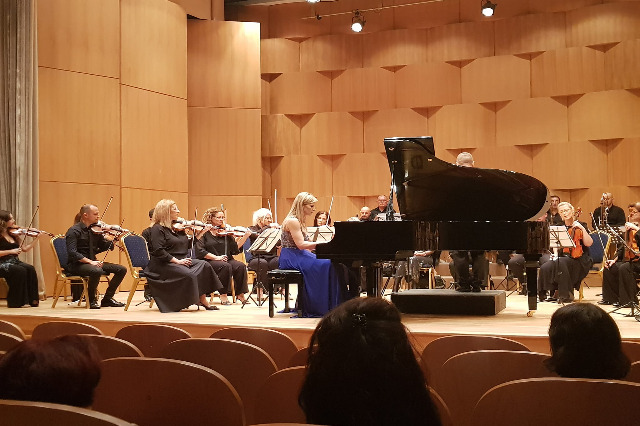
The classical concert “Liszt 212 years” featured the works of composer Franz Liszt, including a premiere performance. The Symphony Orchestra, conducted by Maestro Oleg Arapi, accompanied the pianist Almira Emiri, who traveled from Hungary to perform as the soloist.
The concert, supported by the Hungarian Embassy and the Municipality of Tirana, took place at the Cultural Center of the Orthodox Cathedral. Artistic director Liman Maloku, along with pianist Emiri and conductor Arapi, made the notable choice to include Totentanz (Dance of Death) in the program, marking its first-ever performance in our country.
In the Romantic era, the allure of medieval themes often led to a shift in focus from moral intent to the fantastic, grotesque, and macabre. A prime example of this transformation is Liszt’s composition ‘Totentanz,’ a set of variations for piano and orchestra that also incorporates the simple song ‘Dies Irae.’
Several of Liszt’s works, such as ‘Totentanz,’ ‘Funerailles,’ ‘La lugubre gondola,’ and ‘Pensee des morts,’ reflect the composer’s deep fascination with themes of death. Within Liszt’s compositions, we find clear manifestations of his obsession with death, religion, and the concepts of heaven and hell. In the early 1830s, Liszt’s interests took him to places like Parisian hospitals, casinos, gambling houses, asylums, and even prison dungeons to witness the condemned. These experiences deeply influenced his creative expressions.
Conductor Oleg Arapi emphasized the enduring status of classical music as elite art over centuries. He stressed the significance of providing all generations with this spiritual nourishment, which was one of the primary motivations behind organizing this classical concert.
/m.ll/
Të ngjashme

Latest News







Korça attracts autumn tourists as New Year bookings begin
Most read










 RTI