
 English
 Français
 Deutsch
 Italiano
 Turkish
 Greek
 Serbian
Albania at the Venice Biennale with Iva Lulashi’s “Love as a Glass of Water”




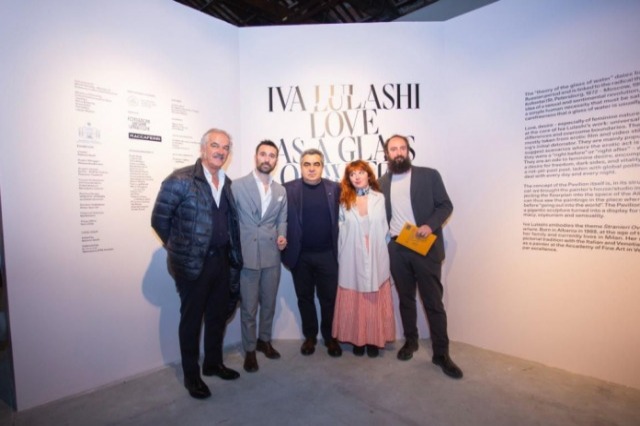
Today, at the 60th edition of the International Art Exhibition – Biennale di Venezia, the Albanian pavilion is represented by Iva Lulashi, with the project “Love as a Glass of Water”, made possible by the Ministry of Economy, Culture and Innovation.
Present at this event, Albanian Minister of Economy, Culture and Innovation, Blendi Gonxhja said that ““Love as a Glass of Water”, the work of Iva Lulashi, revolves around universal subjects capable of overcoming differences and borders, not only geographical ones. It manages to delve into the dimensions of visual culture and the tension that is created between consciousness, the public, and intimacy that evoke feelings that have long been treated as taboo, especially during the Albanian communist period“.
Albania, he continued, has not always had the face it has today, it used to generate interest about the danger and insecurities it evoked, while today it is a well-known attraction so close to this art center where we are now.
“In order to continue the quality integration of our country and our artists in the world scene and discourse, we have considered that it is very significant and urgent to bring all these subjects to these exhibition spaces, to create a coherent framework of where we are today, not only as a location, but as attitudes and projections towards the future,” said Gonxhja.
The macro theme of this edition of the Venice Biennale, April 20 – November 24, is “Strangers everywhere” and comes under the artistic direction of Brazilian curator Adriano Pedrosa.
The topic Iva deals with is triggered by the “glass of water” theory, which belongs to the period before the Russian revolution and is related to the revolutionary feminist thinker Alexandra Kollontai (1872-1952).
It is a theory related to the idea of the sexual revolution, where impulses are seen as a simple human need to be fulfilled with the ease of drinking a glass of water. With a very large influence in Russian artistic and literary circles, these ideas began to be hindered and persecuted by the revolutionary political apparatus.
“Although the metaphor of the glass of water is related to the ease of drinking, we must not forget that water is that vital element, just like a girlfriend. And, it is absurd that topics like love and sexual desire occupy a very small part in the art that is produced today and they are never at the center of large or small activities, as if talking about taboos that are not talked about, or how light issues, not worthy of attention,” says curator Antonio Grulli.
According to him, the question that the artist raises through her work is: Why are such fundamental feelings, which give meaning or destroy our existence, even more than political issues, treated so little by artists?
“Exactly, the work of Iva Lulash is placed in this artistic gap. Love, desire, especially feminine, instinct are at the center of her work. “Love and instinct as a universal language, able to overcome the different, the borders, not only geographical, but also those that exist between us; love as the primary force of man and the world that moves the sun and the stars,” adds Grulli.
Curator Antonio Grulli explains that the theme of the biennale “Foreigners everywhere” has a double meaning. “First, it means that wherever you go or find yourself, you will encounter strangers: they are/we are everywhere. Second, regardless of location, we are essentially always strangers. And, at the Art Biennale 2024, we will talk about artists who are themselves foreigners, immigrants, part of the diaspora, asylum seekers, refugees…”.
Iva Lulashi is one of them. Born in Albania, but educated in Venice, in this city that brings together young people and artists from all over the world, where cultures intermingle. Lulashi’s painting is also a stratification of the Albanian school with its artistic journey in Venice.
/a.p./
Të ngjashme



Latest News








Most read










 RTI