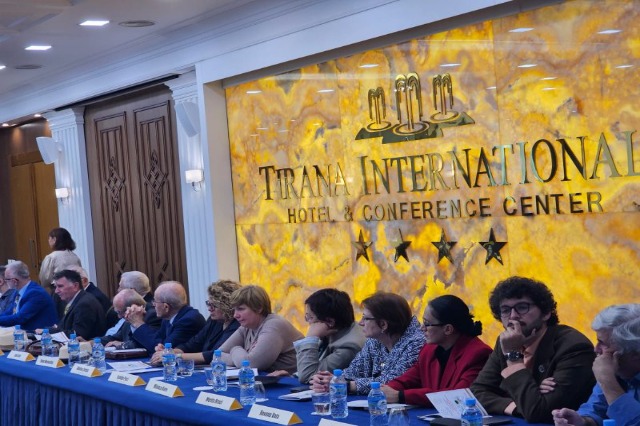
The Albanian Academy of Sciences, in collaboration with the Institute of Comparative Indo-European Linguistics and Albanology at Ludwig Maximilian University in Munich, is hosting an international scientific roundtable titled “Albanian Among Indo-European Languages: Its Origins and Antiquity.”
This scholarly event will take place today and tomorrow (November 4-5, 2024), featuring presentations by over 25 researchers from Albania and abroad. The forum was inaugurated by the President of the Academy of Sciences, Academician Skënder Gjinushi.
The roundtable draws on recent advances in Indo-European linguistics supported by interdisciplinary methods, particularly referencing a groundbreaking study in the journal Science by Paul Heggarty and 33 co-authors. Their research, based on historical-comparative linguistics, suggests that the common Indo-European language dates back 8,100 years, with divergence occurring after approximately 1,000 years. The study, which includes Albanian, examines its three variants—standard Albanian, Gheg, and Arbëresh—indicating a distinct separation of the Albanian language around 6,000 years ago.
The main author of this study will present a focused analysis on the Albanian language’s origins, with findings expected to affirm both a 6,000-year split and a shared 8,100-year heritage. Furthermore, the study suggests that the ancestors of Albanians likely migrated westward into the Balkan Peninsula, diverging from Indo-European branches in the north.
Academician Gjinushi emphasized that this roundtable represents an advancement following the Second Congress of Albanian Studies, held in Tirana three years ago. He noted that the study by Professor Heggarty and co-authors has heightened scholarly interest in the ancient roots of the Albanian language.
“Professor Paul Heggarty’s study in Science, attributing an ancient origin and point of identification for Albanian—estimated between 6,000 and 8,000 years—has captured the attention of Albanologists and inspired us to organize this forum for an in-depth scientific dialogue,” Gjinushi remarked.
According to Gjinushi, people have a deep-seated interest in their linguistic origins. The latest findings not only align with but also enhance the field of Indo-European studies, offering greater precision and a richer understanding of these ancient linguistic relationships.
/a.c/

 English
 Français
 Deutsch
 Italiano
 Turkish
 Greek
 Serbian


















 RTI