
 English
 Français
 Deutsch
 Italiano
 Turkish
 Greek
 Serbian
Albanian Alphabet Day: Celebrating Unity, Heritage, and the Power of Language




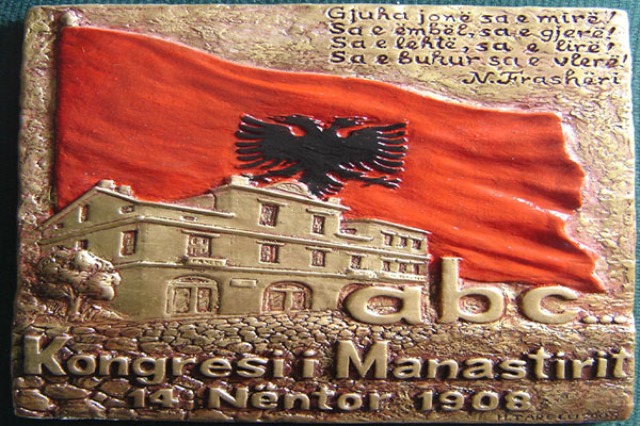
Today officially marks Albanian Alphabet Day, celebrated to honor the unification of the Albanian alphabet, which took place 116 years ago at the Congress of Monastir. This celebration is expected to become a traditional observance, growing in significance across all Albanian-speaking regions.
The Congress of Monastir, or the Alphabet Congress, was an academic conference held in the city of Monastir from November 14 to 22, 1908, focused on standardizing the Albanian alphabet. The 22nd of November is now observed as a commemorative day in Albania, Kosovo, North Macedonia, and the Albanian diaspora, known as Alphabet Day. Before the Congress, the Albanian language was represented by six or more different alphabets, not counting their variants.
The Congress of Monastir was the gathering of Albanian intellectuals from November 14 to 22, 1908, in Monastir, which was then the center of the Vilayet, to determine the official alphabet for the Albanian language. At the time, several different alphabets had been created for the Albanian language. One of the most recent was the Istanbul alphabet, known as the “Istanbul Alphabet.”
The prevailing view was that non-Latin letters were unsuitable for the unification of the Albanian language and its national linguistic unity. For this reason, the active and well-known society “Bashkimi” in Monastir convened the First General Congress to discuss a unified alphabet. A standardized alphabet would mark the beginning of Albanian literature as a whole. Thus, on November 14, 1908, the Congress of Monastir or the Alphabet Congress convened.
The Congress saw the participation of 160 delegates from all parts of Albania, as well as from Albanian communities in Romania, Italy, Greece, Turkey, Egypt, and the United States. Gjergj Fishta was elected president of the Congress, and Parashqevi Qiriazi, a teacher at the girls’ school in Korça, was chosen as the secretary of the commission. Grigor Cilka from Korça was appointed vice president, along with 11 other members. The Congress was attended by Albanians of various religious faiths—Muslims, Catholics, Orthodox Christians, and Protestants—united in their pursuit of a great national goal.
A printing press was also established in Monastir, funded by a group of patriotic Muslim Albanian traders. The Monastir printing press quickly became well-known throughout Albania for distributing books and newspapers in the Albanian language.
Seventeen workers were employed at the press, using a new electric printing press powered by hand to print the weekly newspaper ‘Bashkimi i Kombit’ (Union of the Nation), as well as Albanian primers and school textbooks.
Meanwhile, the issue of the Albanian language often sparked violent attacks from fanatics who mercilessly opposed the advancement of the Albanian language. Father Dudë Karbunara (1842–1917) from Berat, who worked closely with Kostandin Kristoforidhi, began reading the Gospel in Albanian during church services, leading to threats from Orthodox religious leaders. In 1895, fanatics burned down his house.
Orthodox priest Captain Stathi Melani carried books in Albanian under his arm, armed with a rifle, traveling from village to village in southern Albania to promote Albanian-language schools and churches. His activities drew the attention of Turkish authorities, who burned his house and books three times, but Father Melani remained undeterred. On December 24, 1917, he was ambushed and beheaded by a band of bandits led by Josif Suropullos.
The patriotic newspaper ‘Shkreptima’ from Cairo published a memorandum written by the rebels fighting in the mountains of Albania. The document emphasized that their goal was not to plunder or kill but to fight for “the freedom of education in the Albanian language with the national alphabet, the freedom to open all Albanian schools closed by the Turkish government, the establishment of printing presses, and the publication of banned newspapers, as well as the release of political prisoners.” The message concluded with: “Let the entire civilized world, and especially the Ottoman Empire’s government, know that all Albanians, both Gegs and Tosks, Christians and Muslims, will not cease fighting for these three demands until the government guarantees them.”
Even in this struggle, Albanian-language schools emerged victorious. Despite limited resources and teachers, but fueled by a strong desire for Albanian education, Albanian schools succeeded from north to south, preparing generations of patriotic youth. Although this cultural development was initially imagined as non-violent, it quickly became a fierce struggle. Albanian heroes like Isa Boletini and Ismail Bej Qemal Vlora hastened their steps to declare Albania’s independence on November 28, 1912, in Vlora.
A few months later, the Balkan War began, and Monastir and Skopje—two cities historically populated by Albanians—were occupied by the Slavs. All Albanian-owned shops and books were burned, and many Albanian patriots were killed by the Serbs, with others imprisoned. The Muslim Albanian population was forced to abandon the city of Skopje and Monastir, while the remaining Orthodox Albanian families there were subjected to violence and forced assimilation, losing their Albanian identity over time.
The celebration of Albanian Alphabet Day is a profound reminder of the unity, resilience, and cultural pride that define the Albanian people. It honors the legacy of the Congress of Manastir and the visionaries who secured a unified identity through the power of language. By commemorating this day, Albanians not only pay tribute to their heritage but also inspire future generations to cherish and preserve the linguistic and cultural foundation that continues to bind their nation together.
Të ngjashme

Latest News



Most read










 RTI