
 English
 Français
 Deutsch
 Italiano
 Turkish
 Greek
 Serbian
Byzantine art, the meaning of the “Metamorphosis” painted by Onufri.




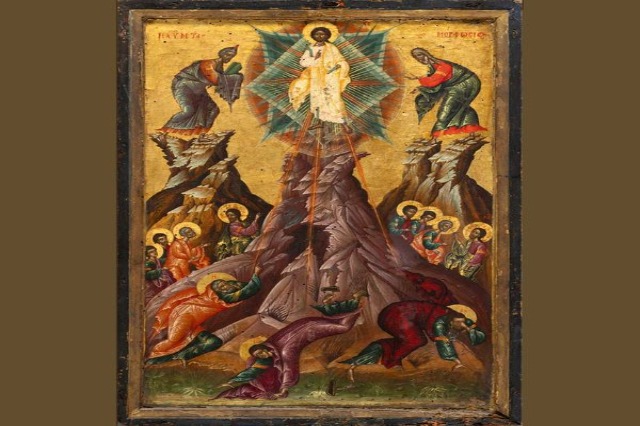
The Museum of Medieval Art has launched a new cycle titled “Discover Byzantine Icon,” through which the public can become acquainted with icons, their meanings, and the rules by which Byzantine art operated.
“Metamorphosis”, an icon from the 16th century, was painted by the master Onufri for the iconostasis screen of the “Annunciation of the Virgin Mary” church in the city of Berat.
“Metamorphosis” icon represents the key to Orthodox theology regarding divine revelation.
The Museum explains that in this icon, three bands are seen. In the upper part, we have the figure of Christ in the center, and on either side are two prophets, Moses and Elijah. In the center of the panel, we see the ascent to Mount Tabor and then the departure from it. And in the lower part are three apostles, Peter, John, and James, with fearful expressions.

The clothing of Christ is always white, indicating purity, joy, and glory. His posture is calm and blessing, while the two prophets bow to him. Their participation in this scene symbolizes the word and deed in the Old Testament. The word spread by the prophet Elijah, while the deed by the written laws given to Moses. The event takes place on the mountain because the mountain symbolizes the union of earth with heaven. Behind the figure of Christ, we see three mandorlas symbolizing the Trinity, from which emanate very strong rays of light, based on the Holy Scriptures that “God is Light,” not in matter but in energy. The three disciples who are below are blinded and frightened by this dazzling light which they had not encountered before.
So this scene illustrates the revelation of the divine nature of Christ, apart from the human. In the central band of the icon, Onufri with his mastery depicts Christ twice with the disciples: on the left showing them the place of the event and on the right explaining to them about the event.

/k.s/
Të ngjashme


Latest News




Most read










 RTI