
 English
 Français
  Deutsch
 Italiano
 Turkish
 Greek
Greek Serbian
EC on the Growth Plan: Half of the Funds Will Be Used for Infrastructure, Transport, and Digitalization




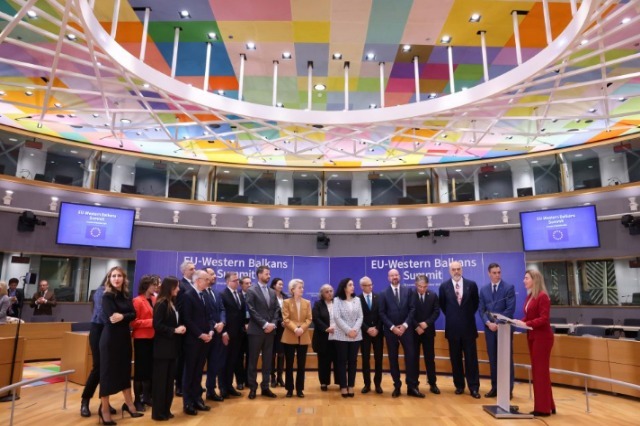
At least half of the European Commission’s (EC) Growth Plan fund package for the Western Balkans is allocated to investments in infrastructure, including transport, energy, and the green and digital transition.
As reported by European Western Balkans (EWB), the remaining portion of the funds will be provided as direct budgetary support to national governments, according to the European Commission’s explanation of the Growth Plan’s funding mechanisms for the Western Balkans.
The first funds from this financial instrument are expected to be released soon, once the European Commission officially approves the Reform Agendas submitted by Albania, Montenegro, North Macedonia, Serbia, and Kosovo. On the other hand, it remains uncertain whether Bosnia and Herzegovina will receive the funds at the same time, as the country has been delayed in approving the Reform Agenda.
The EU aims to allocate seven percent of the total funds from the Growth Plan as pre-financing to all partners in the Western Balkans who adopt valid Reform Agendas. This instrument, covering the period 2024-2027, is an EU financial mechanism worth six billion euros, designed to double the economic growth of the region over the next decade.
From the total amount, two billion euros will be distributed as grants, and the remaining four billion euros will be provided in the form of loans with favorable interest rates. It is estimated that Serbia will receive 1.58 billion euros, Bosnia and Herzegovina 969 million, Albania 922 million, Kosovo 888 million, North Macedonia 807 million, and Montenegro 383.5 million.
Discussing the procedures for releasing funds from the Growth Plan, the European Commission told EWB that “it will be conditional on the successful implementation of the Reform Agendas, which cover both fundamental and socio-economic reforms, in close cooperation with the EU.”
The European Commission adds that in the Reform Agendas, “reforms are divided into quantitative and qualitative steps, which will serve as payment conditions, and each step has a specific implementation timeline.”
Lastly, the European Commission emphasizes that the EC “may reduce or recover amounts if the Union’s financial interests are affected or if beneficiaries have seriously violated an obligation arising from agreements under the Facility.”
Të ngjashme


Latest News








Most read






 RTI
RTI