
 English
 Français
 Deutsch
 Italiano
 Turkish
 Greek
 Serbian
FM Hoxha at Diaspora Summit says language preservation defines national identity, calls demands in North Macedonia legitimate




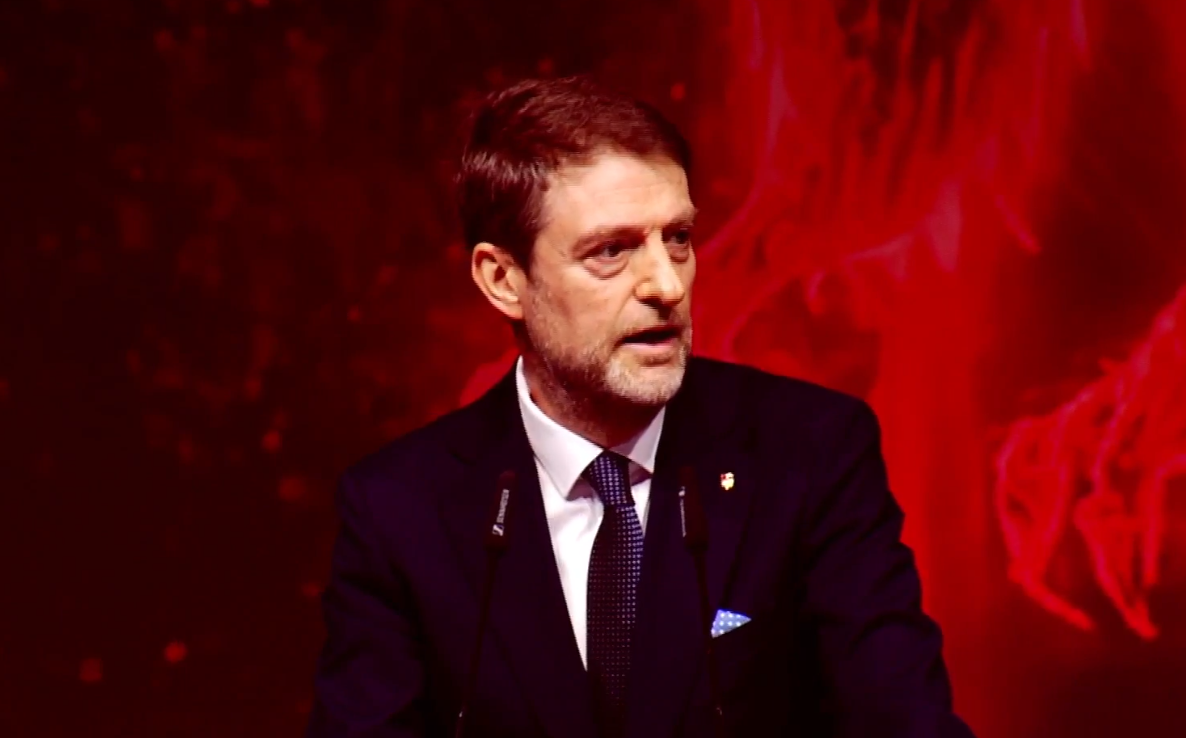
TIRANA, April 14 – Ferit Hoxha opens his address at the Fourth Diaspora Summit in Tirana by positioning the Albanian diaspora as an inseparable part of national identity, and he immediately anchors that argument in language preservation as the defining cultural line.
Building on that framing, he describes the Albanian language as “our DNA, memory, identity and continuity,” linking its protection directly to the survival of national consciousness, since he argues that weakening the language would simultaneously weaken collective existence.
From that point, he shifts responsibility inward and stresses that safeguarding the language depends primarily on Albanians themselves, particularly at a time when higher education levels and stronger global connectivity should, in his view, reinforce rather than dilute linguistic identity.
Within that same logic, he refers to Albanian students in North Macedonia and describes their demands for mother tongue rights as legitimate, presenting them not as isolated claims but as part of a broader need to secure equal linguistic rights across Albanian communities outside national borders.
He then extends the argument to the diaspora infrastructure itself, highlighting teachers, volunteers and community organizers who maintain Albanian-language education abroad, and he emphasizes that their work requires stronger institutional backing and sustained government support.
At the policy level, he states that Albania aims to strengthen the position of the Albanian language within the European linguistic space as part of the Indo-European family, while also situating diaspora history within a continuum of sacrifice, resilience and success.
Against that backdrop, he notes the participation of representatives from 38 countries in Tirana and describes the capital as a shared meeting point for Albanians worldwide, before concluding that relations with the diaspora no longer function as a one-directional link but instead require continuous institutional engagement and mutual attention.
/a.p./
Të ngjashme


Latest News


Most read










 RTI