
 English
 Français
 Deutsch
 Italiano
 Turkish
 Greek
 Serbian
Folk clothes of Lunxhëria




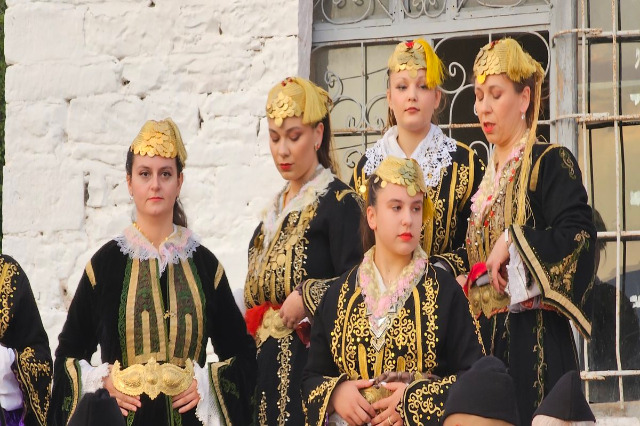
The rare costume from the province of Lunxhëria has traveled the world, adorned with silver-thread embroidery.
Each folk costume represents a specific territory, encapsulating the history and values of the area. However, the Swimwear costume is undoubtedly one of the most beautiful in our country. Among the rarest treasures of Albanian ethnography, the costume of the girls and brides of Lunxhëria has managed to endure to this day in its most original form.
The Lunxhiotë dress stands out as one of the rarest treasures in Albanian ethnography, known for its unique, diverse, attractive, and captivating at first glance. It has garnered appreciation from travelers and researchers worldwide who have explored Lunxhëria.
Not only the Lunxhiotë, but all Albanians take pride in the Lunxhiotë costume that has gained recognition worldwide. The costume of Lunxhëria is believed to be at least 2,000 years old.
Indeed, the Lunxhëria area is rich in ancient settlements, including the capital of ancient Epirus, Antigonea, built by Pyrrhus of Epirus. This region, with its early inhabited areas and developed civilizations, has continuously passed down its culture from generation to generation. Among these cultural inheritances is the traditional Lunxhiotë costume, which has endured and evolved to the present day.
The locals refer to this rare clothing as “lunxhe,” signifying its exclusive connection to the province. This region, situated on the slopes of Mount Lunxhëria, facing the city of Gjirokastra, preserves the ancient city of Antigone as a significant relic from antiquity.
The Lunxhiotë costume, along with the Lunxhe headdress, has been in use since ancient times and is unparalleled in its age. It distinguishes itself through its originality, freshness, and the complexity of its overall features and components. It stands as a source of pride for all of Albania and represents a remarkable facet of traditional Albanian attire worldwide. Through silver-thread embroidery and small buttons, it not only showcases the beauty of nature but also reflects the soul of the wearer.
All the primary components of this traditional Lunxhiotë costume were cut, sewn, and embroidered over 100 years ago. The front parts, the headpiece adorned with tassels and five gold rings, the necklace with three gold rings on the chest, the hooks arranged in a belt around the waist, the sleeves, and other elements, all embroidered with various colors and motifs, which bear witness to the remarkable artistry of the time.
The woman adorned herself in a woolen gown, typically black in color, embellished with strings of various colors. Additionally, black or dark blue velvet was employed, embroidered with silk and gold thread.
Today, original bathing suits crafted using traditional techniques are a rarity. These costumes are handed down through generations, from mothers to daughters, and are cherished and meticulously preserved. The costumes hold immeasurable value, both monetarily and spiritually, for their owners, as well as contributing significantly to the broader cultural heritage of Albania.
The clothes were traditionally crafted by local artisans, and the Lunxhiotë dance has gained widespread popularity. A key activity that plays a vital role in preserving the cultural heritage of the Lunxhëria area is the “Divani Lunxhiotë.”
/m.ll/
Të ngjashme

Latest News



Most read










 RTI