
 English
 Français
 Deutsch
 Italiano
 Turkish
 Greek
 Serbian
Folk Costumes of Shkodra




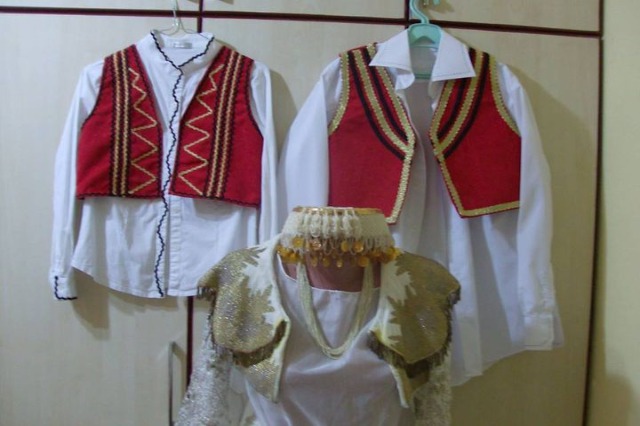
Cultural heritage encompasses both tangible and non-tangible cultural wealth, serving as a comprehensive repository of cultural values carrying the historical memory and national identity, with scientific or cultural significance. Clothing is one of the most important elements of folk art.
Shkodra, with its 2500 years of history, is known as a city with ancient cultural traditions, reflected in its traditional folk costumes.
Muslim Women’s Attire: It consisted of a long shirt down to the ankles with wide sleeves. The material used was silk. The shirts were embroidered by women with gold threads, silk threads, or silk-covered copper wire on the sleeves and neckline. Under the shirt, women wore a cotton or linen undershirt, depending on the season.
On top of the shirt, they wore a tight velvet vest, especially embroidered in the front, fastened at the chest with four clasps. The vest was embroidered with gold threads and motifs. Over the vest, a velvet jacket was worn, with sleeves down to the wrists. This too was embroidered with ribbons and gold threads on the cuffs and shoulders. The lower part of the body was covered with wide loose pants.
Catholic Women’s Attire: Over the long shirt down to the ankles, women wore wide loose pants made of shiny fabric. The vest on both sides of the chest had 20 sewn clasps covered with gold silk thread. The vest was beautifully decorated with floral and sometimes zoomorphic patterns. Both front and back sides of the vest were adorned with 3-5 gold ribbons. Over the vest, a long jacket was worn, made of red pieces with white stripes, embroidered with black silk ribbons. A soft belt with various colors and patterns was draped over the vest. A long, sleeveless coat was worn over the entire body. On the head, a scarf was worn, embroidered with gold threads.
Fustanella Attire: The most characteristic part of this attire for Muslim men was the fustanella. It was a wide skirt with multiple layers, made of white cotton fabric. It was narrow at the waist and descended to the ankles. On both sides, there were two belts between the layers, while a silk belt, 4-5 cm wide and in various colors dominated by white, red, and blue, was worn around the waist. Below the knees, the skirt was tied with a black silk ribbon about 3 cm wide, along with white cotton or linen socks. The upper part included a tight vest with long sleeves. The vest was decorated with simple ribbons arranged in straight parallel lines or intertwined on the front side. This attire was characteristic of the wealthy and middle-class urban layers.
This is a comprehensive Albanian costume with ancient origins deeply rooted in history. In documents, this attire was first mentioned at the port of the Drin River in 1335. Until the early 20th century, it was worn by men in both the southern and northern parts of the country. Shkodra’s men retained it until the declaration of Independence, and in some special cases, until the early 20th century.
Wide Loose Pants Attire: This attire was common for Catholic townspeople from the mid-19th century to the early 20th century. It was made of imported black fabric or locally woven cotton fabric. The cutting method created as many pleats as possible with a uniform width from the middle to below the knee.
/k.s/
Të ngjashme

Latest News




Most read










 RTI