
 English
 Français
 Deutsch
 Italiano
 Turkish
 Greek
 Serbian
Fterra: The village of springs, knowledge and memories




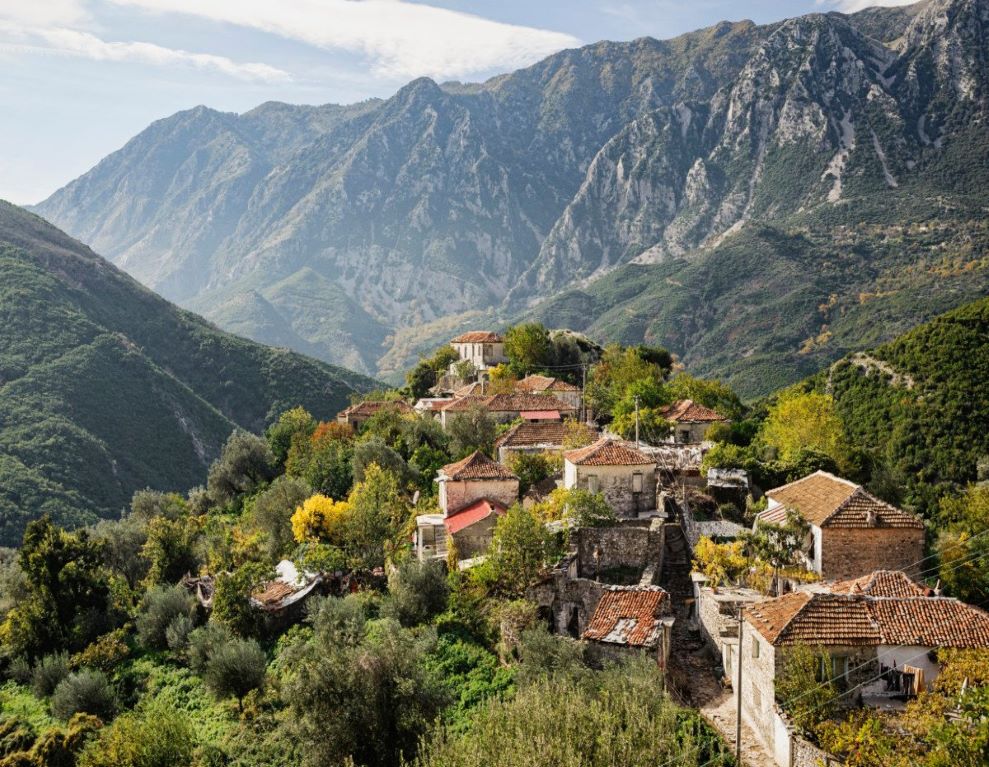
Nestled among the mountains of Lower Kurvelesh, Fterra is a village rich in natural beauty, history and cultural heritage. Its stone houses, traditional courtyards and numerous natural springs create a unique landscape along the road connecting Borsh with Kuç.
Local tradition tells the story of four brothers who settled in the area and established its first neighbourhoods. Although historical documents do not confirm this legend, it remains an important part of the village’s identity.
The earliest written record of Fterra dates back to 1431, when an Ottoman register mentioned the settlement under the name Efteran, with 12 registered households. By 1583, the number had increased to 24.
Fterra also has a strong educational tradition. In October 1916, just four years after Albania declared independence, the village opened its first Albanian-language school with around 20 pupils. A decade later, girls joined the classrooms, marking an important step for the local community. Over the years, many teachers from Fterra worked across the country, earning the village the name “the village of teachers”.
The village also preserves memories of its past through family collections. Profit Zani, the village head, keeps his father’s typewriter, used by teacher Naim Sulo Zani, as well as a radio dating from 1955. These objects reflect the educational and technological changes that reached the community during the last century.
Furthermore, Fterra has produced several distinguished figures in Albanian science and culture. Among them are archaeologist Muzafer Korkuti, environmentalist and documentary filmmaker Xhemal Mato, surgeon Besim Elezi, linguist Hamlet Bezhani and legal scholar Ismet Elezi.
The village also maintains its musical heritage through Lab folk polyphony. Established in 1947, the group “Fterra in Song” has represented local traditions at regional and national festivals.
Meanwhile, the newspaper “Our Fterra”, first published in 1997, continues to preserve the village’s history, family stories and cultural traditions. A local library, established by Profit Zani, also safeguards hundreds of books, photographs and historical documents.
Like many rural communities, Fterra has experienced migration. However, families who moved to other Albanian cities and abroad continue to maintain strong connections with their birthplace.
Today, its natural springs still flow beside the old stone houses, while its books, photographs and family memories keep its history alive.
Fterra is more than a picturesque mountain village. It is a place where nature, education, science and tradition come together, preserving a remarkable part of Albania’s cultural identity.
/a.c/
Të ngjashme





Most read







 RTI