
 English
 Français
 Deutsch
 Italiano
 Turkish
 Greek
 Serbian
National Assembly for Albanian Language: Manastirliu – United to Protect and Strengthen Our Linguistic Heritage




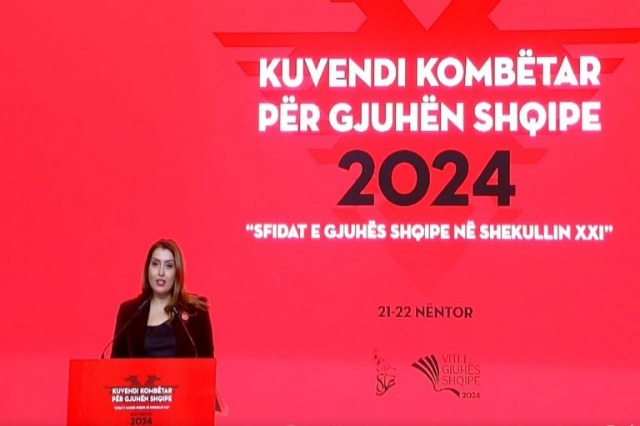
National Assembly for Albanian Language opened today with a special ceremony at the Brigades Palace in Tirana, marking the start of a two-day forum focused on the challenges and opportunities the Albanian language faces in the modern era.
This inaugural assembly brought together representatives from educational institutions, as well as renowned figures in education, linguistics, literature, scientific research, and public communication. Among the attendees were also young people, students, and high school students.
Prime Minister Edi Rama was also present at the opening ceremony, delivering a message to the National Assembly for Albanian Language.
In her turn, Minister of Education and Sports, Ogerta Manastirliu emphasized the significance of the Albanian language as a fundamental pillar of national identity and history. She stated that for Albanians, the language represents the soul of the nation and the historical journey of their civilization. While stating that everything the people have experienced is reflected through the language, Manastirliu underscored that the assembly’s purpose is to protect, strengthen, and take pride in this linguistic heritage. She also highlighted the importance of declaring November 22nd, the day of the Congress of Manastir, as a national holiday, as well as the designation of 2024 as the Year of the Albanian Language. This, she said, clearly reflects the commitment to preserving, promoting, and developing the national language. According to Manastirliu, rapid technological developments, mass migration, and the interaction with other cultures call for thorough preparation, particularly in language.
As part of the Year of the Albanian Language, Manastirliu noted that the Ministry of Education is working to modernize the education system, starting with the update of the Curriculum Framework. She explained that the modernization process includes updating core curricula and subject programs to address teaching challenges and align them with the new competencies that students must acquire. She mentioned that the work on the new core curricula and subject programs, starting with Albanian Language and Literature, is already underway. This includes the development of updated textbooks and the provision of digital tools and multimedia resources for teaching and preserving the language.
Manastirliu also addressed the government’s commitment to supporting the Diaspora. She underscored that, in the Year of the Albanian Language, support for the language in the Diaspora is especially important. The government is funding the “Teachers for Greece” Program, which supports teachers of Albanian language in Diaspora. For the first time, she said, the Albanian government will fund this program and financially support teachers who teach the language to Albanians abroad. This initiative, she added, will lay the groundwork for extending the program to other countries where the teaching of Albanian continues voluntarily, with the dedication of patriotic associations abroad.
Finally, Manastirliu stressed the importance of collaboration among professors, academics, and teachers to preserve and enrich the Albanian language. She acknowledged that reaching all corners of the world is a challenge for professors and academics but emphasized the need to maintain communication networks with their former students, now teachers, to cultivate the language. She underscored the necessity of planning work on a new Dialect Atlas of Albanian and assured the audience of full support for this effort.
The opening of the Assembly also featured messages from academics and representatives of higher education institutions.
National Assembly for the Albanian Language, organized by the Ministry of Education and Sports, will continue for two days, on November 21 and 22. This comprehensive event provides a platform for discussing the challenges and opportunities the Albanian language faces in the modern era, bringing together figures from government, education, linguistics, literature, scientific research, public communication, as well as young people, and students.
/a.p./
Të ngjashme
Latest News

Most read










 RTI