
 English
 Français
 Deutsch
 Italiano
 Turkish
 Greek
 Serbian
Painter Naxhi Bakalli about the magnificent mural, “The Withstand”, a triumph over the evil and how the war threatens civilization




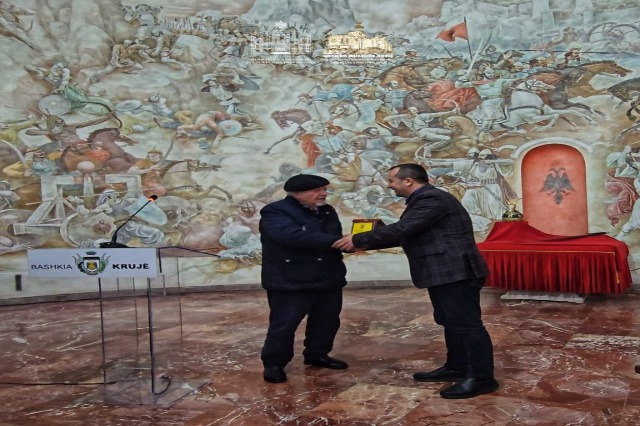
The mural “The Withstand ” in the “George Kastrioti Skanderbeg” National Museum in Kruja leaves special and unforgettable impressions on the many tourists who visit this museum.
“The Great Master”, the painter Naxhi Bakalli, the author of this magnificent and monumental work, tells about its realization as the most culminating part of the triumph over the evil.
“This painting was thought out in advance, in the studio. Later it was defined in every detail how the mural would be. It is painted with the guarantee of a wall that does not undergo transformations due to the environment, the duration of the image on the wall, the technique and especially the content of the drama of the work where the most culminating part is the triumph over the evil, which is the war that threatens human civilization in the whole sense of the word, in the historical process at every point of the globe,” says Bakalli.
The painter underlines that this undertaking is based on these attributes to prove with the language of purity the strength to survive. This is the most precious thing that this mural contains.
“The many details are what, in my opinion, strengthen the idea of survival and the historical event in these conditions, where the most humane part is given, which is the civilized part that must continue and live for centuries or years to prove that nothing it is done easily, but with many sacrifices and sometimes with losses,” says the master of folk motifs in Albanian painting.
Naxhi Bakalli was awarded the title of “Honorary Citizen of Kruja” within the activities organized three days ago on the 580th anniversary of the “League of Lezha”.
With the title “Honorary Citizen of Kruja” four well-known artists who have worked on some of the main works in this museum, Janaq Paço, Genc Hajdari, Bashkim Ahmeti and Gazmend Leka, were also honored by the Kruja Municipality.
Janaq Paço, “Sculptor of the people” (posthumously) has been honored for the realization of the works “Skanderbeg on the Horse” in the city center of Kruja, as well as for the realization as a co-author of the sculptural group “Skanderbeg and the People” at the entrance of the National Museum “George Kastrioti Skanderbeg”.
Genc Hajdari was awarded as the other author of “Skanderbeg and the People” at the entrance of this museum as well as several other works in this museum.
The realization of this sculpture took three years. It was initially thought by the designing architects that only the standing statue of the National Hero should be placed in the entrance hall of the museum. For this reason, the 65-year-old master Paço (author of the equestrian monument of Skanderbeg located in the city center of Kruja, 1959) made several different variants, but the artistic-state commission of the time suggested that Skanderbeg be in ccompany of his warriors and the people.
In this variant, the figure of Skanderbeg was complemented to the sides and back by other warrior figures in the sculpture, which continue in altorelief to the arched space of the background in the lobby of the second floor of the museum.
Master Paço and Genc Hajdari have created a special, realistic sculptural group that harmonizes beautifully with the architecture of the museum. The work creates an impressive situation with the artistic power and grandeur of the monumental figures. Skanderbeg is the central figure in the sculptural group. It is made in full monumental shapes and a warm plastic.
“The Great Master”, Gazmend Leka was honored by Kruja Municipality for the realization of several works in the museum and co-leader of the interior design of the George Kastrioti Skanderbeg Museum in Kruja.
Bashkim Ahmeti, “Great Master” is appraised for the realization of the mural painting “Convent of Lezha”. Three different events take place in the painting. The fresco begins with the return of Skanderbeg to Kruja and the romantic meeting of two figures, Skanderbeg and his mother, Vojsava.
Further, in the center of the fresco, the main moment of the gathering of the Arbëresh princes by Skanderbeg in the city of Lezha (League of Lezha, March 2, 1444) is given.
The fresco closes again with the image of two figures, the knight who is symbolically receiving a message-parchment rolled up, at the moment of departure to spread the news of the creation of the Arbëresh princely coalition.
/a.p./
Të ngjashme

Latest News

Most read










 RTI