
 English
 Français
 Deutsch
 Italiano
 Turkish
 Greek
 Serbian
The 7800-year-old settlement is discovered in Lin, by Lake Ohrid, the archaeologist talks about the identification of the first farmers in Europe




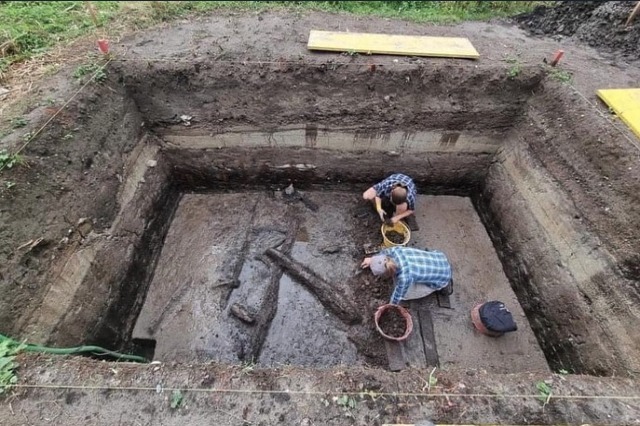
A 7,800-year-old Palafit settlement has been discovered in Lin of Pogradec. From the works of the Albanian archaeologist Adrian Anastasi and the Swiss Albert Hafner, we learn that we are dealing with the oldest settlement in Europe.
In an interview with journalist Andri Xhahu, the archaeologist Adrian Anastasi, who led the archaeological research expedition in Lin, said that “it is some 7800 years old settlement. This is the earliest dating we have received. The settlement, which covers 3,500 hectares, was not all built on one platform. On this surface, it has continuously built for about 8 centuries.”
Researches by Lake Ohrid and Lake Prespa have started about 10 years ago. “These are researches framed in a big project ‘Underwater archaeological map of the Albanian coast’. In addition to this settlement, we have identified two other settlements by Lake Ohrid that were not known before. There is a settlement that is close in time to the one we are studying in the village of Buqeza in Lin, and another that belongs to the Late Bronze Age. We always talk about stilt dwellings,” the archeologist clarifies.
“This one has attracted the attention of Swiss researchers. It was then deemed necessary to carry out a project focused on the dating of this archaeological site. “The ‘University of Bern’ is a leader in Europe in respect, and Professor Hafner is the director of the Institute of Archeology of this university, which has powerful laboratories.”
Archaeologist Anastasi tells about the typology of the constructions of this settlement. “The settlements of the Middle Neolithic are represented by the construction of three dwellings, which were connected to the Lake coast. About 7 meters towards the lake, they had a wall or fence with wooden piles that came in an arched shape to have a kind of protection. There are many hypotheses about what they were protected from, nature, animals or groups of people. We managed to clearly identify the protective construction of inserted pine logs of dimensions ranging from 30-40 cm. There is no documentation in other archaeological sites in the peninsula that is as clear as the one we have identified and are currently working on.”
Asked about the population of this settlement, Anastasi reveals: “We are in the process of identifying the first farmers in Europe. That population, which was not nomadic, eventually settles down and starts cultivating agriculture. We also have a change in the architecture of the settlements, from land to water. They were engaged in hunting and fishing. It is enough to know the area of Lin field and Qafë Thana, to understand why these people have chosen Lin. It is this landscape that attracted these people to eventually settle during that period.”
The archaeologist emphasizes that this discovery is a very important scientific result because it marks a new site in the architecture of settlements. “Why did these people go from building on the ground to building on the lake coast? Why did they make a choice that was more difficult, that required energy, time and economy? The fact that they built it means that there was a greater force that compelled them to do it. This is what we seek to clarify in our research. It is quite important to know the beginnings of the transition from constructions on land to coastal constructions. This is big time news. Then it is necessary to understand all the mechanisms and to rebuild this community, the way they lived. More accurate answers can be given after 7-8 years.”
/a.p./
Të ngjashme



Latest News







Most read










 RTI