
 English
 Français
 Deutsch
 Italiano
 Turkish
 Greek
 Serbian
The lute at UNESCO, experts meet with the community of rhapsodes




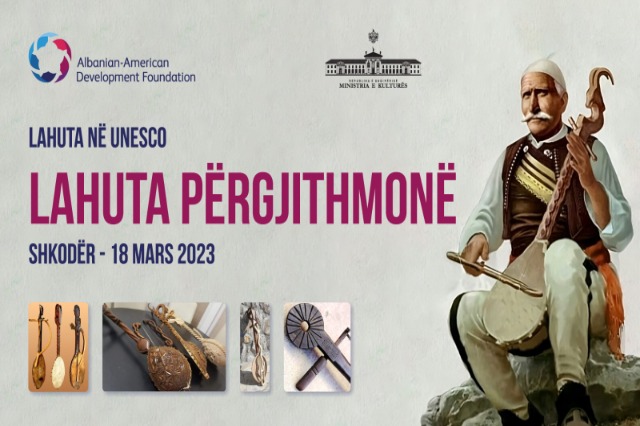
The AADF Foundation and the Ministry of Culture organized the meeting of the group of experts with the community of rhapsodes and the inheritors of the art of making the lute, coming from Malësia e Madhe, Tropoja, Puka, Lezha and Mirdita, at the weekend in Shkodër.
The meeting was opened by Ilir Parangoni, who announced the steps taken by this foundation to enable the preparation of four national heritage files for registration in the UNESCO lists: Jubleta, Transhumance, Tropoja dance and the Lute.
Also present was Australian researcher Susane Ogge-Milou, who has supported the work of the expert group since the beginning. The entire activity was directed with scientific and professional responsibility by the researcher Rigels Halili, a member of the working group.
Academicians Vasil S. Tole and Shaban Sinani, members of the working group from the Academy of Sciences, referred to the topic “The lute today in Albania: lute songs, rhapsodes and the craftsmanship of the instrument’s production”.
In the introductory speech, academician Vasil S. Tole emphasized the importance of registering the lute and lute songs in the list of endangered properties of UNESCO.
In the first part, the importance of the lute as the earliest chordophone instrument of the Albanian tradition was emphasized, which is part of a European family of instruments similar in name and function, its “cousins” that appeared all over the continent in that period known as the “golden age” of the flowering of the coexistence of the three Abrahamic faiths in Spain and further in the interior of Europe.
At the same time, the lute is also the instrument with the most possibilities of interpretation of great narrative poems, first of all of the legendary heroic epic. The lute range map and the epic range map are correspondingly overlaid. Where there is epic, there is lute; where there is lute, there is epos.
Answering the question why the lute is in danger, the researchers pointed out that it has not been quiet for at least two centuries. Sharkia and Ciftelia are the earliest risk takers of the lute and the epic. With their appearance, the lute begins to lose space and the epos to lose syllables.
At the end of the debates, the researchers proposed the adoption of the defense with a special status of Lute players and makers, specifying its standard; the promotion of the formation of new rhapsodes in the environment where the last Lute players live; the assumption of responsibilities by the local government in the regions where the lute survives for financial support to them; completion of a map of the area where the traditional lute is kept and some other measures.
/a.s/
Të ngjashme




Latest News



Albania inspects Kanina Castle as conservation work continues

Most read










 RTI