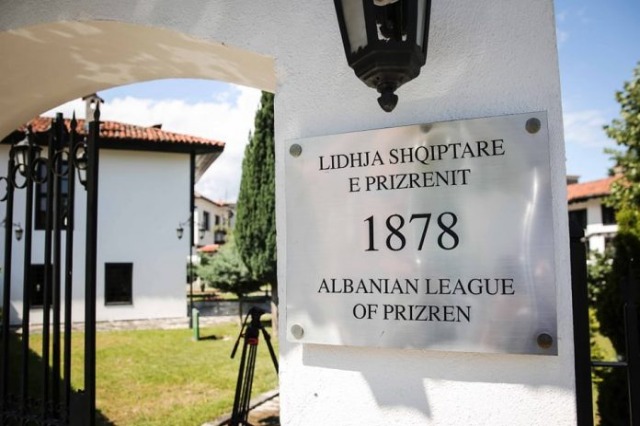
Today marks 81 years since the assembly of the Congress in Prizren, which lasted until September 20 and established the Second League of Prizren, a national political organization dedicated to the unification and protection of ethnic territories.
The Congress was attended by 45 delegates elected from Kosovo and other Albanian regions. The congress was led by the Executive Committee, chaired by Musa Shehu and accompanied by Asllan Boletini, Shefqet Shkupi, Qazim Bllaca, Tahir Zajmi, Pjetër Vuçaj, Sheh Hasnai, Qemajl Balila, Hivzi Meraku, Luk Simoni, Haxhi Fahrija, and Sokol Dobroshi.
The Chairman of the Executive Council, Musa Shehu, presented the agenda to elect the Congress leadership, which consisted of a president, two vice-presidents, and a secretary.
In a secret ballot, Musa Shehu was elected President of the Congress, Aqif Blyta and Rexhep Krasniqi were chosen as Vice-Presidents, and Bedri Gjinaj was appointed Secretary.
The Congress decided to form the Second League of Prizren, a national political organization committed to the unification and protection of ethnic territories. The Congress elected the Central Committee of the League, composed of seven members. Rexhep Mitrovica, a prominent activist in the national cause, was chosen as the Chairman of the League.
At the Second Congress, held from January 17-21, 1944, changes were made to the leadership of the League. Bedri Pejani was elected Chairman of the Central Committee after Rexhep Mitrovica was appointed Prime Minister of the government established by the Germans in Tirana. The Congress also approved the League’s statute, which was decreed by the Supreme Council on March 14, 1944.
The League also had its own publication, “Lidhja e Prizrenit,” which propagated the idea of creating an ethnic Albania and denounced the crimes committed by Serbs against Albanians in Kosovo. The Second League of Prizren was an organization led by Kosovo nationalist leaders, with Bedri Pejani at the forefront, encouraged during the period when Rexhep Mitrovica was Prime Minister.
Unlike the National Liberation Movement and some nationalist groups engaged in the fight against Nazi-fascist occupiers, the main nationalist forces hesitated to join, fearing that a war led by communists would end with the reestablishment of Yugoslav authority in the region.
Prominent representatives of nationalist circles considered the Italian and later German occupiers as the lesser evil compared to the expected return of Serbian and Yugoslav rule after their withdrawal.
For this reason, after Italy’s capitulation, they developed the idea of convening a national assembly to lay the foundations for a political organization that would protect ethnic territories from the threat of reoccupation by Yugoslav forces following the departure of German troops.
/a.c/

 English
 Français
 Deutsch
 Italiano
 Turkish
 Greek
 Serbian



















 RTI