
 English
 Français
 Deutsch
 Italiano
 Turkish
 Greek
 Serbian
The secrets and symbolism of the icons preserved in the Museum of Medieval Art of Korça




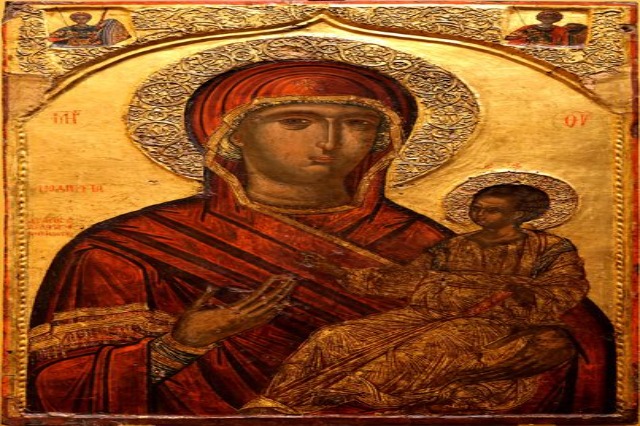
The National Museum of Medieval Art in the cycle “Discover the Byzantine icon” presents the icon of St. Mary Hodegetria.
The icon originates from the church of Saint Mihill /Michael/, Vithkuq, Korça. It belongs to the beginning of the 17-th century from an unknown author. The icon belongs to the “Hodegretia ” type, which is translated as “The Guide” and was conceived on the basis of the holy writings, where the words of Christ “I am the way” are mentioned. Saint Mary appears holding Christ on her arm. Her hand is stretched and directed towards the child, instructing as “the only way we must follow”.
Christ holds in his hand a closed scroll which symbolizes the word of God. Following this path, his word is revealed, where the expression “The word was the first” comes to life.
Christ, although appearing in the body of a child, his features look like those of an adult and signify the great knowledge he carries even at a young age.
In the Christian world, the figure of Saint Mary is also known as the spiritual leader of humanity. The Virgin Mary, mainly in iconography, appears dressed in red, which symbolizes the human part, the victory of life over death, love and hope for life, and at the same time conveys the pain and blood of her son. With the blue color, it shows her divine nature. The decoration in gold symbolizes the greatness of the Kingdom of God.
In the portrait of the Holy Virgin, the nose is thin and long. Painted in the Cretan iconography technique, it signifies that finding the right path requires a fine sense of smell.
The net that collects the hair of the Mother of God under the upper mantle can be noticed, symbolizing her virginity. Moreover, there are always three stars on the figure of Saint Mary placed on the upper mantle, one in the center of the head and two on her shoulders, which symbolize her virginity, before, during and after the birth of Christ.
/a.p./
Të ngjashme


Latest News




Most read










 RTI