
 English
 Français
 Deutsch
 Italiano
 Turkish
 Greek
 Serbian
Tourist flow in Butrint




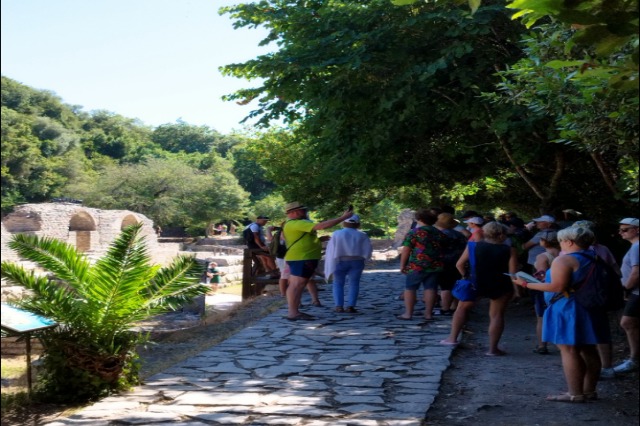
About 69 thousand locals and foreigners, to Butrint Archeological Park, 20 km from Saranda, ruins one of the most visited archaeological park by local and foreign tourists.
Considered as one of the destinations to be visited by lovers of ancient history, this park offers a considerable number of archaeological sites.
According to Albanian News Agency from January until now, Butrint was visited by 68,962 local and foreign visitors.
The flow of visitors is increasing every year. Specifically, compared to last year, the increase in the number of tourists is 23 655 or 52%”. Out of 68,962 tourists, 38,647 were foreigners, mainly Italians, Spaniards, Poles, and French.
Since the beginning of the season, Butrint was a favorite visiting target for tourists from the Nordic countries. For about two hours, tourists are introduced to different epochs of history, in different layers all in one place. The archeology of this ancient city, evidences different cultures in the past, like Hellenic, Roman, Byzantine, Venetian, and Ottoman one.
The greatness of this country was hidden until 1927. The first archaeological discoveries began with the Italian Archaeological Mission. This venture began excavations in what would be one of Albania’s most ancient cities. The works started in 1928.
Although the archaeological works have not yet been completed, it is thought that what we see today may very well be just one of fifth of what is still underground, according to Albanian News Agency.
Butrint today is an architectural complex with 15 areas from different periods, from the 4th century BC to the XVI AD. The historical importance of Butrint is extraordinary and to be able to walk is a privilege. White stone statues from the era of Octavian Augustus, Agrippa, Antiochus, Serapis, Livia Drusilas once stood here, as well as the birthplace of many prominent citizens at different times or Roman generals during the enlightened era of the empire when the city was called “Colonia Augusta Buthrotum” (Augustian Colony of Butrint).
/a.p./
Të ngjashme

Latest News


Most read










 RTI