
 English
 Français
 Deutsch
 Italiano
 Turkish
 Greek
 Serbian
Vlora’s folk costumes




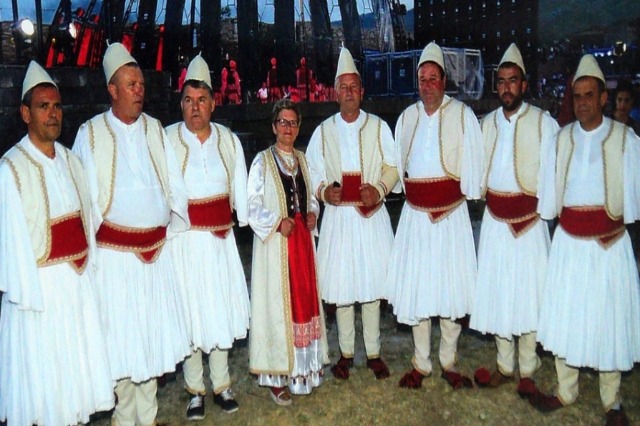
Folk costumes reflect the peculiarities of our culture and artistic tastes, preserved continuously in subsequent historical periods, especially in rural environments.
The folk costume served several practical, social, aesthetic, ceremonial, and ritual functions. In costumes, changes were observed according to social classes and strata. The quantity and quality of the costumes’ decorations and accessories played a significant role. Accessories also played a crucial role aesthetically and ritually, especially in wedding attire. Along with other ethnographic features, costumes varied greatly according to regions, mainly in terms of cutting styles and embellishments.
Traditional folk costumes in the Vlora region are diverse and can be transformed into a real resource for the development of cultural tourism. This diversity of colors and styles in the design of folk costumes is quite interesting from an artistic perspective and perhaps constitutes a feature compared to other regions of the country.
This is well exploited to attract foreign tourists because traditional folk costumes are a continuous object of interest for tourists who choose Albania or Vlora for their vacations.
Traditional costumes have distinctive elements that are related, among other things, to the characteristics of the terrain, regions, climate, etc. In mountainous areas with cold climates and developed livestock, costumes were mostly made of wool. In a particular area of the Vlora River, linen was also used.
The oldest clothing for Lab women is the dress. A later folk costume included citjane(wide pants worn by women), which is a completely different element from the traditional old folk wear, influenced by various historical moments.
Men’s folk costume has more original elements, where the oldest is the one with a long shirt, a fustanella, and a belt. Parts of traditional costumes also include hand-made calf-leather shoes, shoes with pointed tips, shoes with curved soles, as well as a white felt hat with a tuft on top.
The Fustanella costume is a men’s outfit. It gets its name from a kind of white wrinkled bottom, made of cotton fabric. At the top, a short shirt with long sleeves was worn, along with a vest. Around the waist, a wide leather belt was worn, onto which weapons were hung. In the cold season, part of this folk costume was also the woolen cape. Until the beginning of the 20th century, this cape was worn in all Albanian regions.
Similarly, in this direction, the tradition of the village of Narta stands out, where the costumes are entirely unique and do not resemble any others in the Vlora region and even the country. Costumes in this area are mainly crafted with satin (a shiny fabric), which constitutes a unique element in the materials used for folk costumes. This diversity of costumes, colors, and styles is carried on by individuals passionate about tradition.
/k.s/
Të ngjashme

Latest News
Most read










 RTI