
 English
 Français
 Deutsch
 Italiano
 Turkish
 Greek
 Serbian
Wood carving for decorative ceilings, an ancient tradition in Albanian folk art




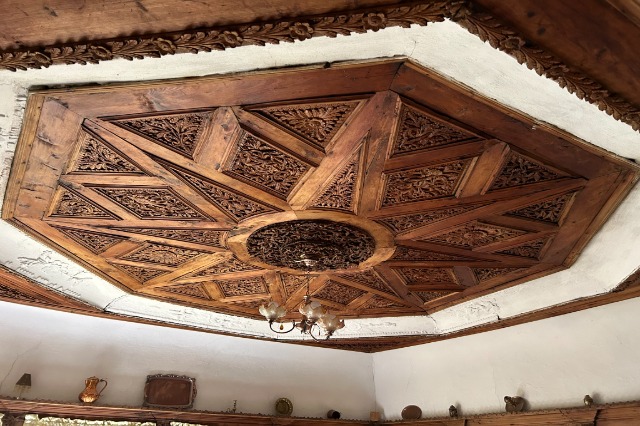
The Regional Directorate of Cultural Heritage in Berat, through a post on social networks, highlights the carved ceilings that adorn the characteristic houses of Berat.
Fatbardha Skopje is the first wood carving specialist in Albania who has found masters of all cities from Shkodra to Gjirokastra. With her experience and systematic field work she provides us valuable data about the history of decoration in Albania and how wood sculpture work has developed in our country. According to her, the decorative ceiling of Vajde Myftiu’s apartment in Berat was carved by master Hasan Teta (wood carver, from Dibra). The same composition can be seen on a ceiling in Elbasan, located in the Ethnographic Museum.
Wood carving has ancient traditions in Albanian folk art. It developed mainly in the hilly and mountainous regions rich in forests. Initially, it was the craftsmanship of shepherds. They worked on decorating musical instruments, cradles, boxes, cartwheels, and other items. Wood carving, as a household craft, met the needs of family life.

The artistic profession of wood carving developed in several regions. The mentioned masters from Dibra, those from Shpiragu (Berat), and those from southern Albania (the Konica region) elevated the art of wood carving to a very high level and created true artistic works. These three regions developed distinct styles of carving. Masters from Gryka e Madhe, Golloborda e Reka, but also from Tetovo and Çermenika, who worked in Northern Albania, Kosovo, and in the South up to Korçë, are known for wood carving. They can be distinguished into two groups. The first group specialized in ceiling, table, veranda, and balcony decorations, doors, etc. The dominant decorative motif was the leaf of the lily, but there were also other geometric plant patterns or stylized figures from nature or mythology. Pine wood was mostly used as material.
From the end of the 19th century onwards, the art of artistic woodwork also developed in cities like Tirana, Elbasan, Shkodra, Prizren, and Gjirokastër.
/k.s/
Të ngjashme


Latest News







Most read










 RTI