
 English
 Français
 Deutsch
 Italiano
 Turkish
 Greek
 Serbian
Religious Tolerance in Albania: Insights from a New Academic Study




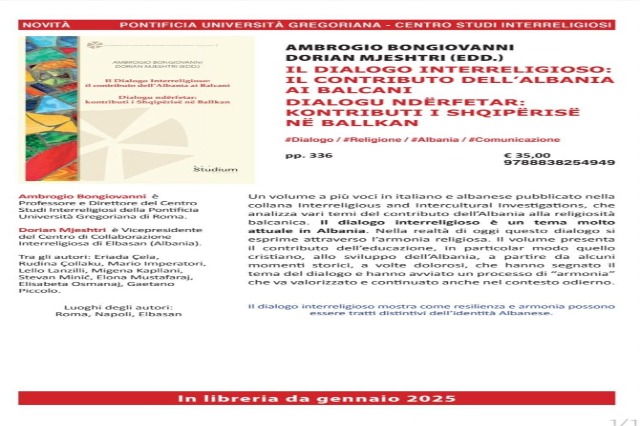
The recently published volume “Interfaith Dialogue: Albania’s Contribution to the Balkans”, released earlier this year in Italy, is supported by the Pontifical Gregorian University and the Center for Interfaith Studies in Rome. This extensive work features contributions from scholars from both Albania and Italy, offering an in-depth exploration of the role and impact of interfaith dialogue in Albania and the broader Balkan region.
“At a time when religious harmony is being tested by evolving social and political challenges, this study seeks to highlight Albania as a unique model of coexistence and religious tolerance,” states the book’s introduction, co-authored by Ambrogio Bongiovanni and Dorian Mjeshtri. Their research is further enriched by contributions from Dr. Erjada Çela, Dr. Rudina Çollaku, Dr. Mario Imperatori, Dr. Lello Lanzilli, Migena Kapllani, Stevan Minçi, Elona Mustafaraj, Dr. Elisabeta Osmanaj, and Gaetano Piccolo.
Key Themes of the 336-Page Volume
- The influence of religious education and cultural heritage on Albania’s development
- The role of religious institutions in fostering sustainable interfaith dialogue
- Religious harmony as a fundamental pillar of Albanian identity
- Challenges and potential threats to this model of coexistence
- Strategies for strengthening interfaith dialogue at both regional and global levels
This multilingual volume, published in both Italian and Albanian as part of the Interfaith and Intercultural Investigations series, examines the role of education—particularly Christian education—in shaping Albania’s historical and cultural landscape. It sheds light on defining moments, including those marked by adversity, that have contributed to Albania’s interfaith relations and the development of a harmonious religious coexistence.
By delving into Albania’s interfaith dialogue, the book underscores how religious tolerance and stability have become integral to the nation’s identity. It further emphasizes the need to preserve and reinforce this tradition within the contemporary socio-political context, ensuring that Albania continues to serve as a model for interfaith coexistence in the Balkans and beyond.
/a.c/
Të ngjashme


Latest News






Most read










 RTI