
 English
 Français
 Deutsch
 Italiano
 Turkish
 Greek
 Serbian
“Finestre sull’Arte”: New Discoveries Reveal Butrint’s Hidden Past




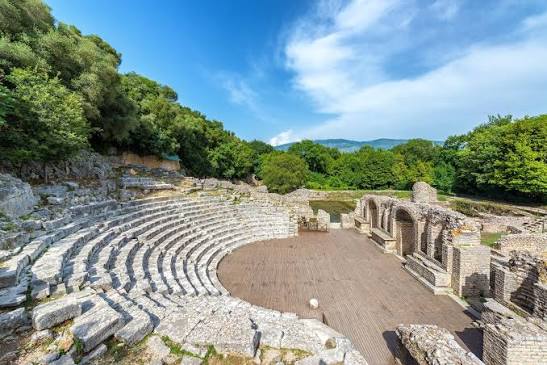
New archaeological research is revealing more of Butrint’s ancient past. A century after Italian archaeologist Luigi Ugolini brought the site back to international attention, researchers have identified previously undocumented buildings, fortifications, water systems and burial sites.
According to Italian art and heritage publication Finestre sull’Arte, these findings shed new light on the history of Butrint and its surrounding landscape, shaped by successive civilizations over thousands of years.
Enrico Giorgi of the University of Bologna leads the archaeological mission alongside Belisa Muka of the Institute of Archaeology in Tirana. The team also works with the University of Siena’s Landscape Archaeology and Remote Sensing Laboratory, led by Professor Stefano Campana.
The project aims to map Butrint Archaeological Park and the nearby Ksamil Peninsula in detail. To achieve this, researchers are using LiDAR technology, which employs laser pulses to map terrain beneath dense vegetation.
Mounted on drones, LiDAR systems produce highly detailed digital models of the ground. These images reveal features that trees and shrubs would otherwise conceal, helping archaeologists identify potential ancient structures.
“Butrint is an extraordinary place: a headland overlooking a lagoon, inhabited almost continuously for millennia,” Giorgi said. However, dense vegetation makes large parts of the park and surrounding hills difficult to explore.
Researchers first use digital maps to identify unusual shapes, lines and depressions. They then visit these locations to check for archaeological remains, using GPS and surveying equipment to navigate the difficult terrain.
Not every anomaly leads to a discovery. Some turn out to be fallen trees or natural rock formations. Others, however, reveal ancient structures that researchers had never documented.
Giorgi described the fieldwork as a slow process, with archaeologists pushing through thick vegetation and thorny bushes to reach their targets. Despite these challenges, the team continues to uncover significant remains.
Inside the archaeological park, researchers identified a building with two apses. Parts of its walls still stand nearly two metres high. Its construction techniques resemble those of Butrint’s Great Basilica, suggesting a possible connection to the city’s Late Antiquity period. Further research must confirm this theory.
The team also discovered a limestone-block well and a large circular cistern on the park’s northwestern slopes. The cistern features a waterproof mortar lining designed to retain water.
Meanwhile, investigations near the acropolis revealed what appears to be a previously undocumented section of the Hellenistic fortifications. The walls consist of large, carefully cut stone blocks. An Italian-Albanian mission had previously conducted excavations in this area between 2019 and 2024.
Another discovery emerged east of the Roman Forum. There, researchers identified a large building divided into two rooms. Inside, they found traces of plaster and a terracotta-tiled floor. A stone threshold and steps lead to an outdoor area with benches. These features suggest that the building may have served a public function, although its exact purpose remains unknown.
The research also extended beyond the park into the surrounding hills. LiDAR surveys revealed additional ancient buildings and numerous burial sites, including graves carved directly into the rock.
At the same time, researchers documented more recent traces of Albania’s history. Bunkers and long trenches reflect changes to the landscape during the 20th century.
Among the ancient remains, the team identified a church with three apses. Its walls rise more than two metres in some places. Researchers also found a neighbouring building that may date to the Roman period.
Together, these discoveries highlight Butrint’s continuing archaeological potential. By combining LiDAR surveys with on-site inspections, researchers can identify hidden structures and connect them with known monuments. This approach also helps them trace the area’s development across different historical periods.
“Butrint is one of the most extensively studied archaeological sites in the Mediterranean, and it has been a long time since it revealed previously unknown monuments on this scale,” Giorgi said.
This year’s campaign, he added, shows that the ancient city still holds many secrets. By combining remote sensing with fieldwork, archaeologists can locate hidden structures more efficiently and without invasive excavation. As a result, they are bringing to light remains that vegetation concealed for centuries.
Të ngjashme

Latest News

American outlet TheStreet highlights Tirana among 2027 travel trends

“Finestre sull’Arte”: New Discoveries Reveal Butrint’s Hidden Past
Most read










 RTI