
 English
 Français
 Deutsch
 Italiano
 Turkish
 Greek
 Serbian
EASTER CELEBRATION IN ALBANIA




Albania is famously known as a country of religious harmony and as such, we celebrate and pay our honors to every sacred day on the calendar, be it a Christian, Muslim, Orthodox, or Bektashi holiday. A couple of days ago, on March 22nd Albanians welcomed the first day of spring otherwise known as Nowruz, which also marks the Persian New Year. Interestingly enough, this celebration comes a week after the Pagan Summer Day, on March 14th. We do love holidays, don’t we?!
Albania has “two Easters,” giving tourists the chance to experience one, the other, or both, depending on when they visit and how long they stay. Catholic are celebrating Easter according to Gregorian calendar, while orthodox Easter are celebrated usually at least a week later than Catholic Easter, according to Julian calendar.
It is interesting that these celebrations now important festive days for each Christian family, while during the communist time for more than half a century this events were banned. No one is allowed even to mention “Easter Sunday” or Christ Resurrection. They couldn’t go to Church or to follow the specific rituals. The communist regime pretended to create an atheist state, so religious days were banned. But when the democratic years came, all the Catholics and Orthodox believers returned to their traditions to celebrate these events according to their own calendars.
But in general they do the same things.
Both Catholic and Orthodox believers attend services throughout Holy Week, from Palm Sunday to Easter Sunday, despite usually going on different dates. Both faiths hold Holy Saturday vigils to welcome Resurrection Morning. Orthodox follow up the vigil with early-morning prayer and song services.
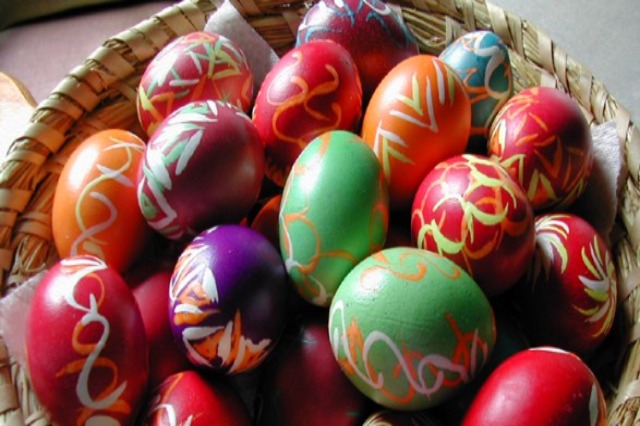
Both faiths decorate Easter eggs, the Orthodox dyeing many of their eggs red to symbolize the blood of Christ. Orthodox also eat a special Easter bread, drink brandy, and eat roast lamb for Easter dinner. In fact all Albanians prefer to take part in cultural or traditional events for Easter, because in our country Catholics, Orthodox, and Muslims often “borrow, mix, and match” religious feasts and practices in Albania. We are known for our religious tolerance and coexistence.
Dyed the Easter eggs is the brightest symbol of Easter and making these vibrant and colorful Easter eggs every year on Holy Thursday always makes me realize that it’s Easter time. It is also very common to dye the eggs other colors, but as red Easter eggs symbolize the blood and sacrifice of Christ, Easter is rarely or ever celebrated without them.
The tradition of cracking the Easter eggs after ‘Christ has risen’, symbolizes the resurrection from the dead and the new life, just like a little chicken cracks the shell and comes to life. The player who successfully cracks the eggs of the other players is the ‘winner’ and is said to be granted luck for the rest of the year.
Make the perfect dyed Easter eggs – Tips
As Easter eggs are not made for celebrating purposes only, here are some tips to make sure that your Orthodox Easter eggs in addition to vibrant and colorful are also perfectly cooked.
When boiling the eggs make sure that they are at room temperature; leave them out of the fridge for 3 hours before start preparing this Easter eggs recipe. Boil the eggs starting with cold water. If you try placing the cold eggs in already boiling water, the shells are more than likely to crack immediately, due to the difference in temperature. Fresh eggs are less likely to crack, but will be more difficult to peel. Add pinch of salt in the water; this will help prevent your eggs from cracking while boiling and make them easier to peel.
After adding the water, the fresh eggs sink in the bottom of the pot. Get rid of the eggs that float on top, as you don’t want your Easter eggs to have gone off.
Stir gently a little bit the eggs, while the water is coming to a boil. This will help centre the yolks (but be careful not to crack the shells). As soon as the eggs are boiled, place them under running cold water to stop the cooking process and help prevent the yolk from forming a less than attractive green crust around them.
For your Easter eggs to have a vibrant color, don’t forget to add the vinegar, or else your ‘red’ Greek Easter eggs will become pink and pale. Give a little shine on your dyed Greek Easter eggs by wiping them with a paper towel with olive oil.
A traditional Easter soup is characteristic on Easter! It is a soup made from lamb offal garnished with fresh herbs and with a delicious egg lemon sauce.
This traditional soup is the dinner prepared and served in almost every household on Holy Saturday, while the main Easter meal served on Easter Sunday is spit roasted lamb. The soup is designed to use the leftover parts of the lamb so that nothing went to waste.
It is served after the midnight church services to break the 40 day Great Lent period and is considered to be best meal after the fasting period to gradually ease your digestive system back into its meat eating habits.
LAMB
One of the most common symbols, especially used during Catholic and Orthodox Easter, is the lamb. The origin of its use is directly related to the liberation of the Jews. In ancient times, the Jews sacrificed a lamb during the holidays. They connect the joyous celebration of Passover with the liberation of the Jews from slavery in Egypt, with the salvation from death, represented by the Resurrection. The popularity of the lamb, as the main food of the Catholic and Orthodox Easter, is related to its importance as a symbol.
EASTER CANDELS
The lighting of the Orthodox Easter candles is a tradition recognized by the Roman Catholic, Orthodox and Anglican churches. Placed in a corner near the altar, the candle is lit on Saturday evening, during the celebrations on the eve of Easter, and from its flame all the other candles of the church are lit. The ritual of celebrating the fire has its origin in the IV century. The Easter candle symbolizes Christ as the flame, his Resurrection as “the light of the world”.
What Albanians Do during Easter
Attend Catholic Easter Services at St Paul’s Cathedral in Tirana. It belongs to the Roman Catholic Archdiocese of Tiranë-Durrës. The stained glass window to the left of the front door features Pope John Paul II and Mother Teresa. Also a statue of Mother Teresa can be found at the entrance of the cathedral. It was inaugurated on 26 January 2002.
Attend Orthodox Easter services at Resurrection of Christ Orthodox Cathedral in Tirana, the capital. The cathedral, finished in 2012, is one of the largest in the Balkans. It has a large 16-bell tower with an Orthodox-style cross on top, which bear fours “Paschal candles” that stand for the light of the four Gospel Resurrection accounts.
But there are many other churches in Tirana and all over the country. The most famous one is Kisha e Lacit (Saint Anthony), one hour far from Tirana. The biggest festive celebrations are held in Shkodër and Lezha, where the catholic community is bigger. So if you are in Tirana these days, you can choose to visit these cities which are two hours from Tirana, and experience the real festive tradition.
In general, after the services in church, people celebrate with their families and friends.
/k.s./
Të ngjashme


Most read










 RTI