Albanian iso-polyphony is a distinctive form of multipart singing and one of the most remarkable expressions of the country’s folk creativity. Because of its outstanding artistic and cultural significance, UNESCO has inscribed the tradition on its Representative List of the Intangible Cultural Heritage of Humanity. As a result, iso-polyphony is recognised not only as a national treasure but also as a cultural legacy of universal value.
Preserved mainly in southern Albania, iso-polyphony forms an integral part of four major ethnographic regions: Labëria, Çamëria, Myzeqe and Toskëria. Although each region has developed its own distinctive style, all share the same essential principle. Several voices interact to create harmonious and deeply expressive performances.
Among these regions, Labëria stands out as the heartland of Albanian iso-polyphony. In particular, it is renowned for its complex forms of multipart singing. Performers here sing in two, three or four parts. Traditionally, women perform two-part songs, while both men and women sing three-part compositions. However, four-part singing remains the richest and most intricate form. For this reason, it is widely regarded as the artistic pinnacle of Albanian iso-polyphony.
Researchers believe that Albanian polyphony began in a simpler form, featuring two principal melodic lines: the Marrësi (lead singer) and the Pritësi (responding singer). The Marrësi opens the song and conveys its central emotional message, while the Pritësi responds and complements the melody. Initially, the responding voice had a less distinct melodic role. This feature remains evident in some two-part songs performed by women in Labëria. Over time, however, the role evolved and acquired a clearer musical function, thereby enriching the interplay between the voices.
Later, the tradition expanded with the introduction of a third voice, the Mbajtësi (sustaining voice). This addition strengthened the harmony and enriched the tonal depth. In particular, the Mbajtësi sustains the harmonic line that connects the other voices and provides the foundation for the performance. Consequently, its introduction marked the emergence of three-part polyphony, which remains widespread today.
The next major stage came with the addition of a fourth voice, known as the Hedhësi (ornamental voice). This voice introduces melodic embellishments and subtle artistic nuances, giving performances greater richness and dynamism. As a result, four-part polyphony emerged as the most complex and celebrated form of the tradition. Practised mainly in Labëria, it remains a defining feature of Albanian musical culture.
Beyond its artistic value, iso-polyphony has long played an important role in everyday community life. For example, it accompanies festivals, weddings and family celebrations, while also marking moments of hardship and sorrow. Through these songs, generations have passed down stories, legends and historical events. They have also preserved words of wisdom and expressions of love, longing and pride. Thus, iso-polyphony is far more than a musical tradition. It is a form of collective expression that preserves the historical memory and spiritual heritage of the Albanian people.
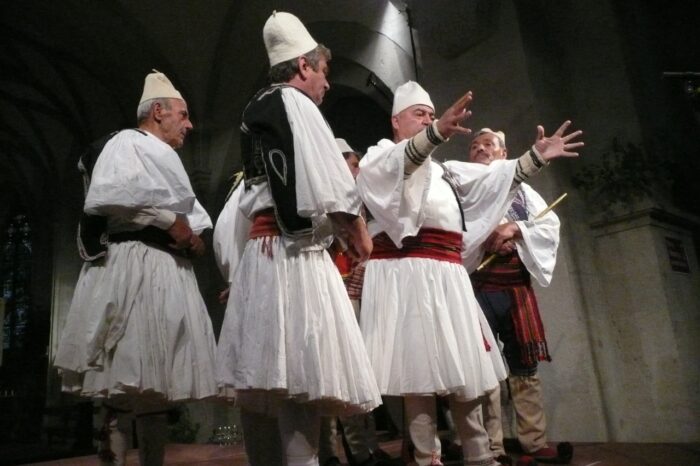
Today, polyphonic groups continue to keep this tradition alive through festivals, cultural events and performances in Albania and abroad. In this way, Albanian iso-polyphony remains a powerful symbol of national identity. It also celebrates the creativity of the Albanian people and strengthens the bond between generations.
Ultimately, this remarkable heritage reminds us that intangible traditions do not survive solely in museums or archives. Instead, they endure through the voices of those who sing, preserve and pass them on. For this reason, Albanian iso-polyphony remains one of the greatest sources of pride in Albania’s national culture.

 English
 Français
 Deutsch
 Italiano
 Turkish
 Greek
 Serbian














 RTI