
 English
 Français
 Deutsch
 Italiano
 Turkish
 Greek
 Serbian
99th Birth Anniversary of Martin Camaj/ National Center for Books and Reading Organizes Symposium




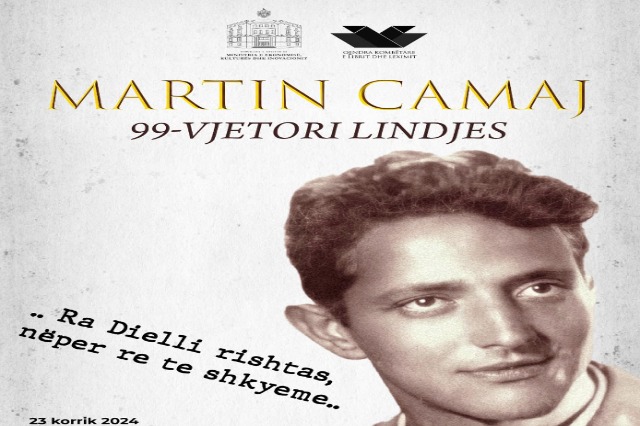
At this event dedicated to Camaj’s work, prominent figures in the fields of literature and Albanian studies, researchers, educators, and others presented.
The symposium was opened by Alda Bardhyli, the director of the National Center for Books and Reading, who stated that Camaj wove words reflecting the realities of early memories from his birthplace, portraits of people who had shaped his journey, and Albania from the distant perspective of an exile.
According to Bardhyli, Martin Camaj’s work is characterized by modernism, placing Albanian literature on contemporary development standards.
Martin Camaj was born on July 21, 1925. He was a poet, writer, and renowned scholar of the Albanian language.
He was born in Temal, Dukagjin. Camaj’s academic research focused on the Albanian language and dialects, particularly those in southern Italy. His literary career, spanning 45 years, had several stages of development.
He began with poetry, a genre he remained faithful to throughout his life, while in his later years, he concentrated heavily on prose. His first volume of classical verse, “Nji fyell ndër male” (A Flute in the Mountains), Pristina 1953, and “Kânga e vërrinit” (The Song of the Meadows), Pristina 1954, were inspired by the inhabitants of his birthplace, the highlanders of the north, with whom he remained spiritually close even after many years in exile and the impossibility of returning.
The poetry of Camaj’s mature period shows the influence of the hermetic movement of the Italian poet Giuseppe Ungaretti (1888-1970). A collection of selected poems was translated into Italian by Francesco Solano in a bilingual edition “Martin Camaj – Poesie,” Palermo 1985 (Poetry), into English by Leonard Fox, “Selected Poetry,” New York 1990 (Selected Poems), and into German by Hans-Joachim Lanksch, “Gedichte,” Munich 1991 (Poetry).
Martin Camaj passed away in Munich on March 12, 1992.
/a.c/
Të ngjashme

Latest News




American outlet TheStreet highlights Tirana among 2027 travel trends
Most read










 RTI