
 English
 Français
 Deutsch
 Italiano
 Turkish
 Greek
 Serbian
Archaeological Research at “Lin 3” Reconfirms: The Oldest Pile Dwelling Settlement in Europe




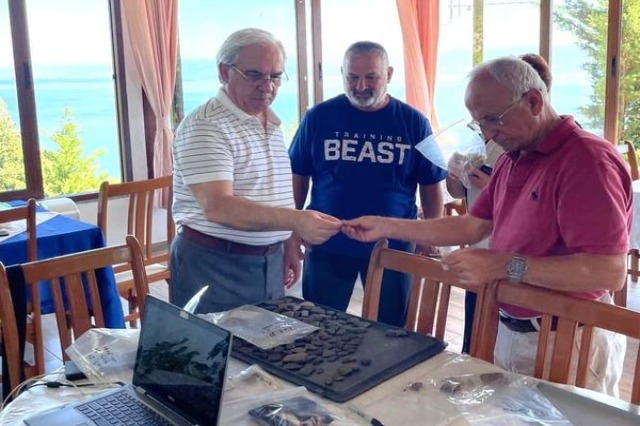
The Chairman of the Academy of Sciences, Skënder Gjinushi, met with members of the Albanian-Swiss archaeological expedition that has been conducting research for several years at the Neolithic settlement of Lin. The expedition leaders informed Gjinushi about the data processing of the archaeological material to ensure and preserve all scientific information through standardized documentation.
The “Lin 3” underwater research project is a collaboration between the Archaeological Institute of the Academy of Sciences of Albania and the University of Bern (Switzerland). Professors Albert Hafner and Ilir Gjipali reconfirmed that the Lin settlement is a stilt (lake) dwelling settlement, mostly submerged and partially on land, as a result of infillings that occurred over thousands of years from soil deposits eroded from the surrounding hills.
The results of previous years’ research (2021, 2022, and 2023) and laboratory analyses conducted at the University of Bern in Switzerland, as well as those in collaboration with the University of Oxford in England, showed that the “Lin 3” stilt (lake) dwelling settlement is the oldest of its kind in Europe.
The 2024 excavations mark the completion of the first phase of the “Lin 3” project. The four-week land excavations (June 24 – July 21, 2024) are considered very successful due to the quantity and variety of archaeological material (stilts, ceramics, stone tools, flint and bone tools, plant remains, domestic and wild animal bones, etc.), which are the subject of ongoing study by project specialists. The second phase of this season’s excavations involves underwater excavations within the lake, which will continue for another four weeks until August 18.
This year’s excavations by the Albanian-Swiss expedition are aimed at further understanding the extent of the settlement, its duration, the material and spiritual culture of the Neolithic inhabitants, the complexity of the constructions of these lake settlements, as well as aspects of agricultural and livestock economy and cultural and chronological relationships with similar settlements in the surrounding areas (in the Korça basin, Northern Greece, and North Macedonia).
Meanwhile, the necessary archaeological documentation is being prepared for its protection and declaration as an archaeological zone by the Ministry of Economy, Culture, and Innovation.
/k.s/
Të ngjashme



Latest News






American outlet TheStreet highlights Tirana among 2027 travel trends


Most read










 RTI